
News
The Jackie Robinson Museum Is About a Lot More Than Baseball
Robinson accomplished a great deal on the field, but a museum celebrating his life puts as much focus on his civil rights work.
READ MOREDue to inclement weather, the Jackie Robinson Museum will be closed today. We apologize for any inconvenience and appreciate your understanding. Plan your visit or become a member today! School field trips are now booking for Fall!
In the era of replay review and automated balls and strikes, the sight of a major league manager leaping out of the dugout to argue with an umpire has become a rarer sight. Other than the cheers (or, more frequently, boos) that accompany each skipper’s announcement at the beginning of the lineup, the modern manager has become a less-visible presence. For Jackie Robinson and fans of the Brooklyn Dodgers in the forties and fifties, however, the men who managed the team were often regarded and scrutinized for their on-field presence as much as the players themselves.
In Brooklyn, Jackie Robinson played under four managers: Leo Durocher, Burt Shotton, Chuck Dressen, and Walter Alston. Robinson, always one to speak his mind, had his opinions on all four. In many ways, he had to. Being the first Black player in the modern major leagues meant that Robinson faced incredible scrutiny from opponents, the press, and even his teammates. The clubhouse presence of a skilled manager can be the deciding factor in how a player—young or old—responds to the demands of the Show. Robinson’s experiences with these managers shaped his own aspirations to manage a team—though no opportunities ever materialized.
When Robinson joined the Brooklyn Dodgers in spring training in 1947, the fiery Leo “the Lip” Durocher stood at the helm of the team. Durocher was, by all accounts, extremely popular in Brooklyn. His brash nature meshed well with the rowdy Ebbets Field faithful, and his competitive spirit earned him the attention of sportswriters across New York. His illicit affair with actress Laraine Day and his associations with mobsters and Hollywood stars caused him to appear in the tabloid pages almost as much as the sports section.
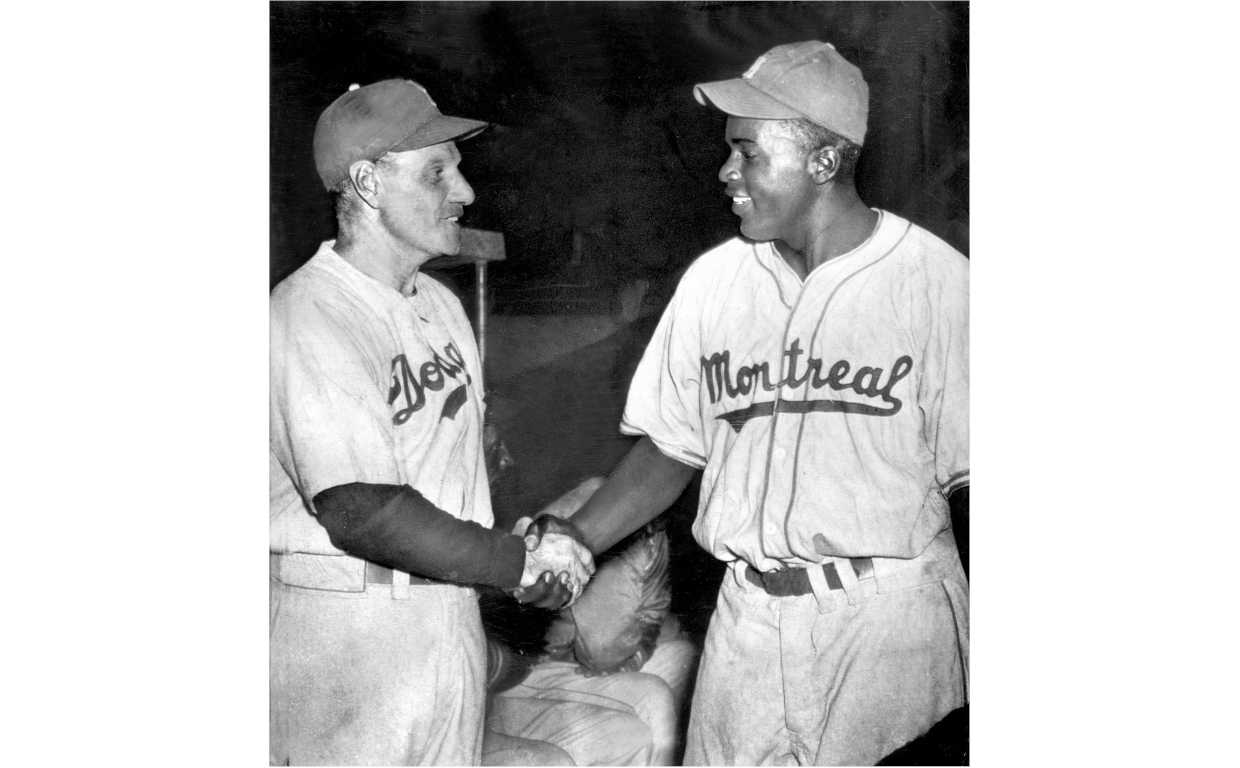
Jackie Robinson and Leo Durocher shake hands during spring training in Cuba, 1947. Getty Images
When Jackie Robinson arrived in 1947, Durocher was an established presence. Over the previous eight seasons, he had led the team to just one National League pennant but had ensured the Dodgers remained in the top half of the league for most of his tenure. Robinson and Durocher shared the same competitive spirit, which proved necessary during the team’s spring training in Havana. As rumors swirled that Robinson would be promoted to the Dodgers from the AAA Montreal Royals that season, some of Jackie’s future teammates began to circulate a petition declaring that they would refuse to play with a Black player. Dixie Walker, Hugh Casey, Bobby Bragan, and Carl Furillo had led the crusade, collecting signatures in the clubhouse to present to team management. Eventually, the plan leaked to Dodger president and general manager Branch Rickey, and he knew just who to call on to quash it.
Durocher, as the story goes, roused his entire squad from slumber in the dead of night and summoned them to a team meeting. There, he declared that Robinson would play if he could make the grade and (in true Leo Durocher fashion) that he would make everyone in the room rich. While many of the dissenters still requested to be traded, the petition fizzled. Durocher had laid down the law.
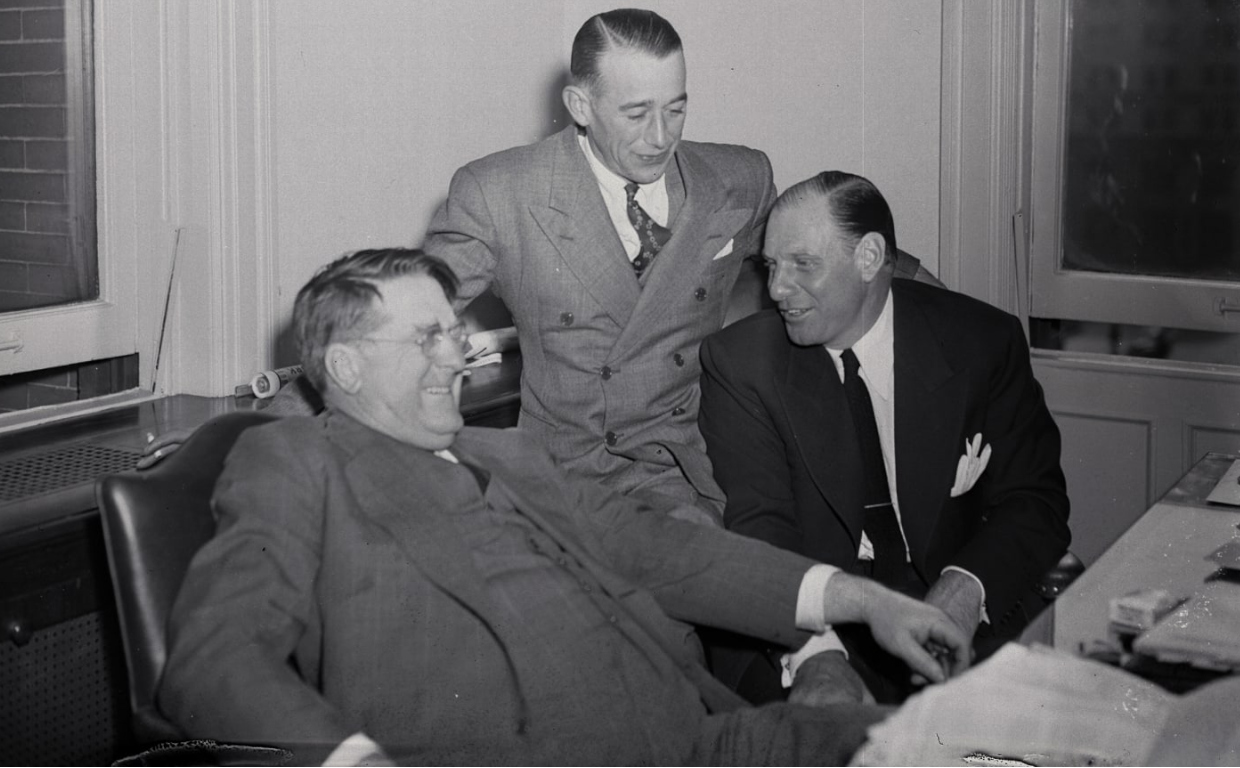
(l to r) Branch Rickey, Clyde Sukeforth, and Leo Durocher in 1942. Sukeforth briefly took over as manager of the Dodgers for two games after Durocher was suspended in 1947. Getty Images
Durocher had one more parting gift for Jackie. Not long after the late-night meeting, his high-flying lifestyle finally caught up to him. On account of his associations with high-profile gamblers, Happy Chandler, Commissioner of Baseball, laid down the law and banned Durocher from the game for a season. Dodger fans, aghast at their decapitated team, were livid. Sports columnists, craving a juicy piece of gossip, spent days on end following the Durocher story. For Robinson, who was preparing to face the scrutiny of millions as he broke baseball’s color barrier, the media circus surrounding the manager relieved some of the public pressure that might have otherwise been heaped on him. When Robinson took the field on April 15, his entrance into baseball was scarcely remarked upon by the white press. While readers (both in the present era and in 1947) rightfully condemned the apathy of the sportswriting class for their apathy to the most important moment in the history of the game, Robinson himself may have been thankful for the reprieve.
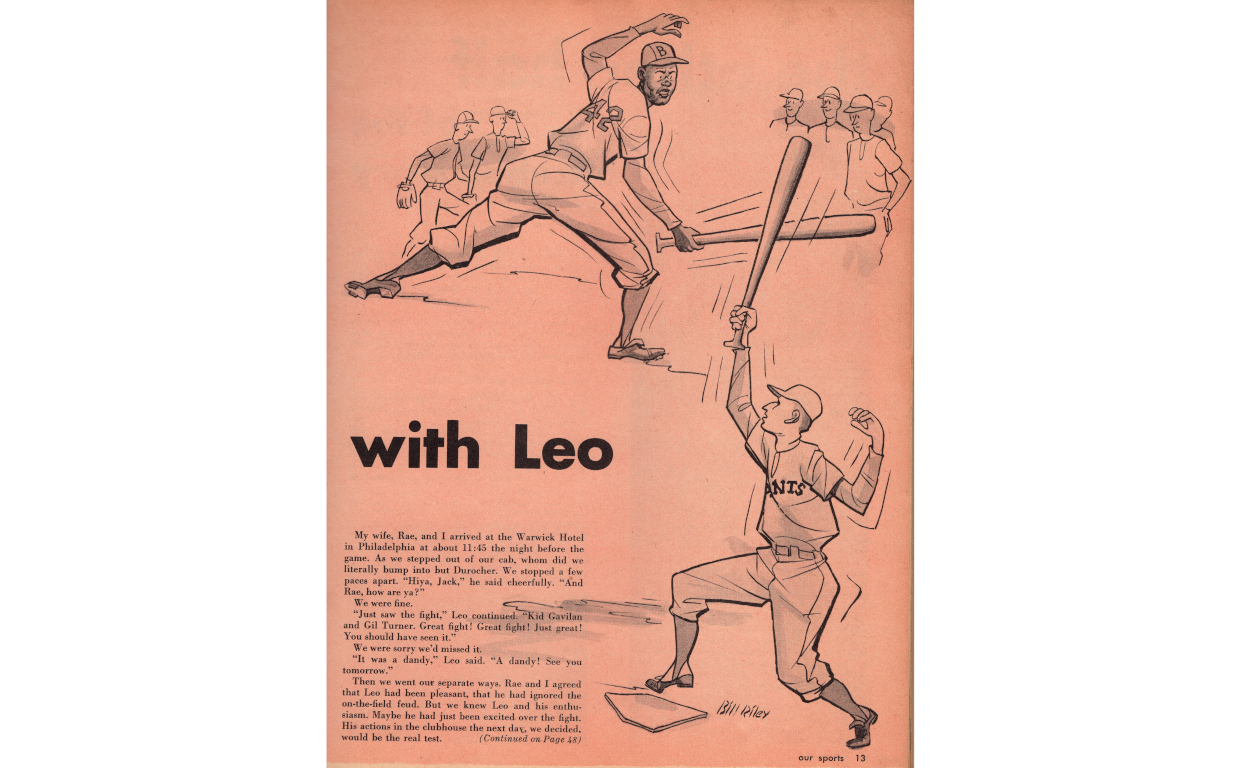
Durocher returned for the 1948 season but quickly left (again scandalously) for the crosstown Giants. No longer bound by their competitive spirit, they spent the next seven years trading barbs and insults from the opposite dugouts whenever their teams met. Jackie would make fun of Leo’s suspension, while Duocher, who himself loved on-field tirade, would punch back about Jackie’s arguments with umpires. Their chirps rarely left the field. In 1953, writing a tell-all about “his feud with Leo” in Our Sports, the short-lived Black sports magazine edited by Robinson himself, Jackie effusively praised Durocher’s gentlemanly character, highlighting various moments when the manager stood up for him.1 From the moment Durocher left the Dodgers to his retirement in 1955, he and Jackie remained bitter rivals—despite their mutual respect.
With Durocher chased from baseball in 1947, Branch Rickey hastily called Burt Shotton out of retirement to come to the helm. Shotton, whose career in baseball began almost forty years earlier with the Saint Louis Browns, was perhaps the polar opposite of Durocher. While Leo would gripe with an umpire who so much as looked at him funny, Shotton wore street clothes in the dugout and never stepped foot onto the field. If Shotton had a disagreement, he would send out one of his coaches on his behalf. His apparent passivity irked the local writers, who had grown used to Durocher’s flamboyance. “Brooklyn’s gentleman bum,” as the Saturday Evening Post described him, disarmed umpires with his unflappable calmness and sharp wit.
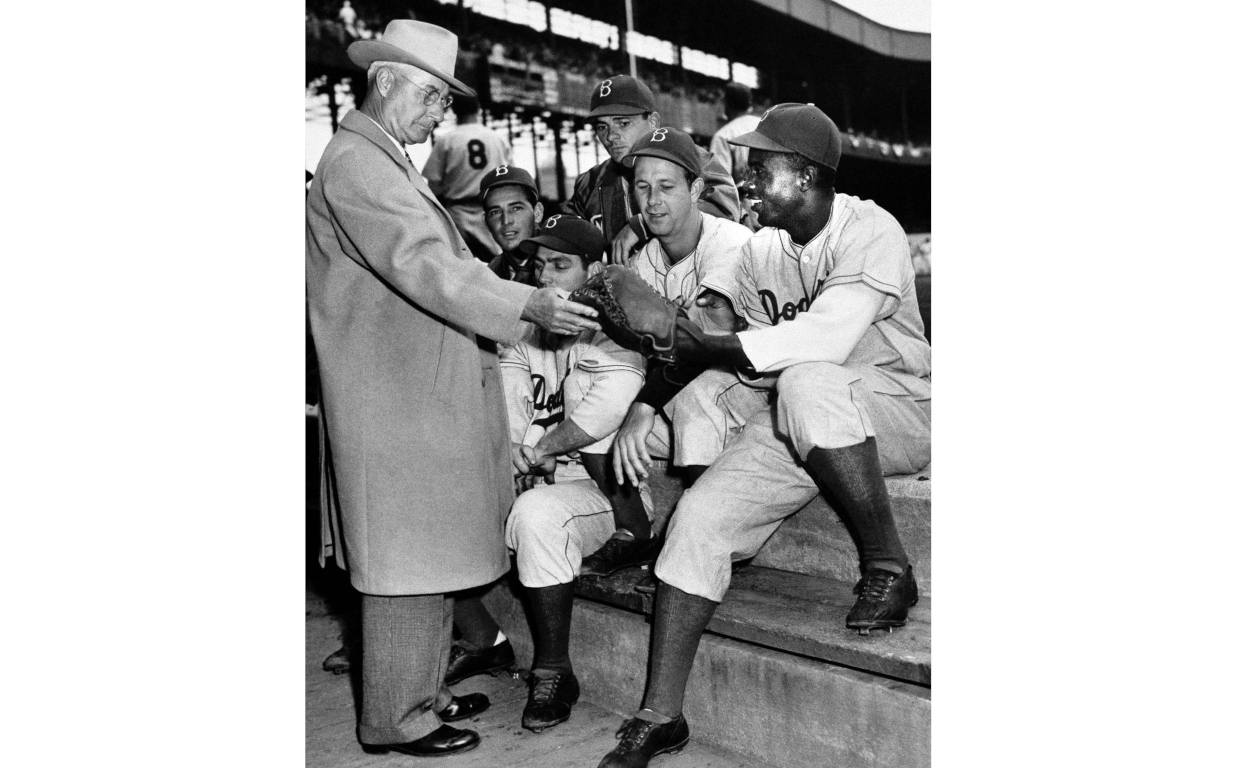
Burt Shotton, left, inspects Jackie Robinson’s glove on his first day as Brooklyn Dodgers manager. Shotton, unlike many of his counterparts, never wore a uniform during games. Associated Press
For Jackie Robinson, Shotton was a key figure in his development as a baseball player. When the manager received his assignment in 1947, he quickly realized he would have a key role to play in the desegregation of baseball. His calm temperament, it turned out, was precisely what Robinson needed. Early in the season, as Jackie went on a 0-for-20 slump, Shotton stood up for him. “As my slump deepened,” Robinson noted in his 1972 autobiography I Never Had It Made, “I appreciated his presence and understanding… There were others who doubted I could field and some who hoped I would flunk out and thus establish that blacks weren’t ready for the majors. Shotton, however, continued to encourage me.”2 The manager approached the question with reasoned nonchalance. “There’s no reason to get excited,” he once calmly replied to a suggestion that Robinson should be benched.3 “No reason to panic.”
Robinson saw Shotton as a manager whom younger players could trust for advice.4 He guided the team to the 1947 and 1949 pennants but was dismissed after the 1949 season when Walter O’Malley took over the ownership of the team. Though his contributions to Robinson’s success on the field cannot be overlooked, his .601 record demonstrated his skill as an all-around leader.
Chuck Dressen took over as Dodgers manager in 1951. Previously a Reds manager and Dodgers coach, Dressen had extensive experience in baseball long before he arrived at Ebbets Field. In many ways, he combined many of Durocher and Shotton’s best qualities: A skilled strategist with a sharp tongue, Dressen was confident to the point of cockiness in his players’ abilities—and his own. Of the managers Robinson played under, Dressen was his favorite. Though Robinson appreciated his baseball mind, he assuredly had a great deal of sympathy for a man who was misquoted and mistreated by the press almost as much as Jackie was.
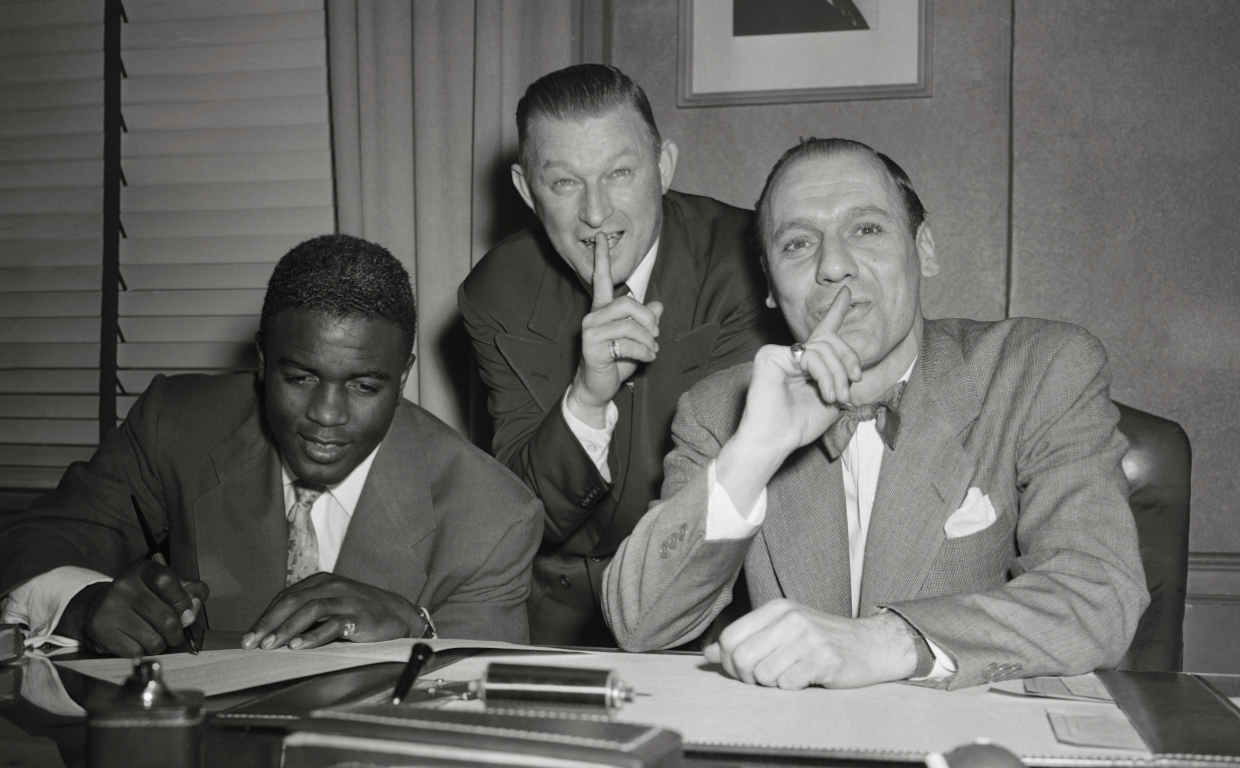
Jackie Robinson signs his 1952 contract alongside Chuck Dressen (center) and general manager Buzzy Bavasi. Getty Images
Dressen, after all, was responsible for one of the most scrutinized managerial decisions in baseball history. In the final game of the three-game playoff with the New York Giants for the 1951 National League pennant, Dressen’s Dodgers entered the ninth inning with a 5 to 2 lead. After starter Don Newcombe gave up a run and began to falter, Dressen summoned Ralph Branca from the bullpen, who promptly gave up a home run to Bobby Thomson, costing the Dodgers the game and the pennant.
Branca had previously pitched poorly against Thomson and had been struggling as of late. When reporters hounded Dressen after the game, asking him why he chose Branca, he noted that he made the decision based on the report from coach Clyde Sukeforth, who said that Carl Erskine, the other pitcher warming in the bullpen, was bouncing his curveball. The sportswriters, looking to sling mud, accused Dressen of blaming the decision on Sukeforth rather than taking accountability himself. Jackie himself quicky came to his defense, declaring that Dressen had the support of the whole team.
Dodger owner Walter O’Malley agreed: “I thought [Dressen] did a good job,” he retorted to a group of writers calling for Dressen to be dismissed.5 “And you all agreed he was a good man when he was 13 games up.”
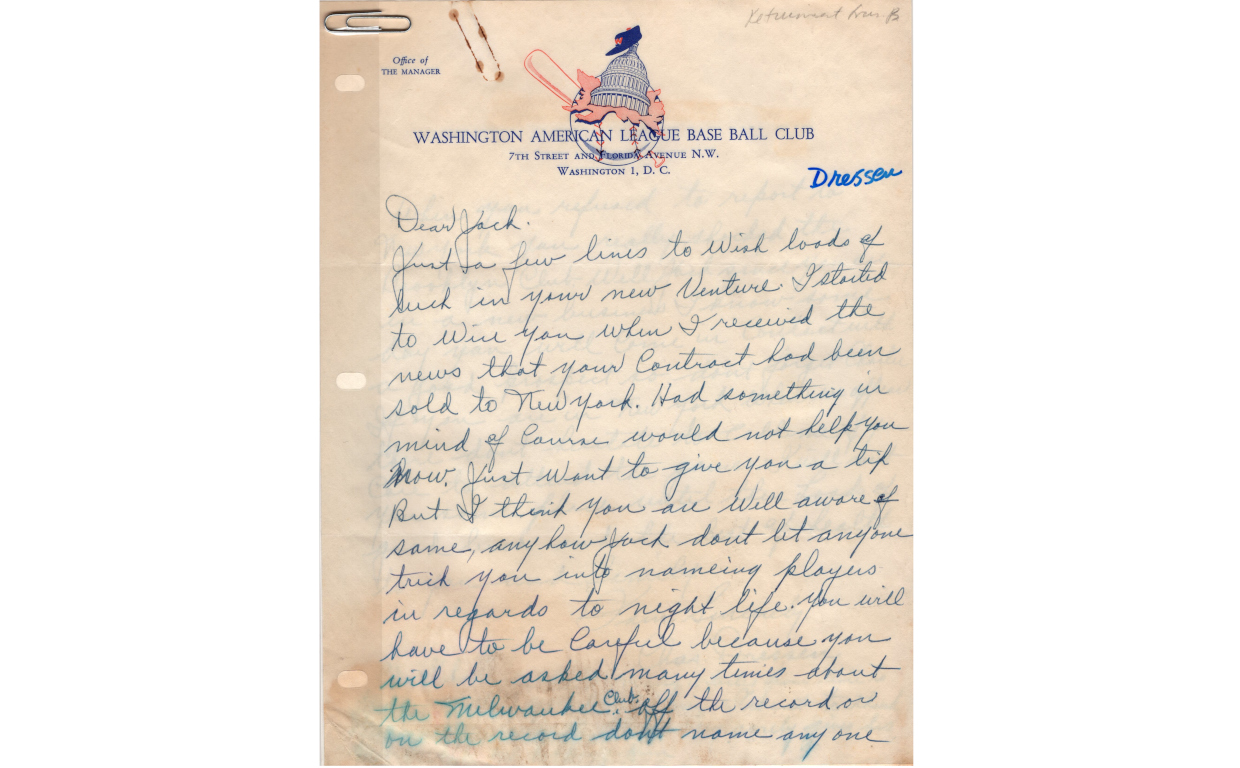
Dressen wrote to Robinson after the latter announced his retirement from baseball in 1957. Here, he offers Robinson advice about talking to the press and wishes him well in his new business. Robinson had recently become the center of controversy when he suggested that the 1956 Milwaukee Braves struggled because their players spent too much time at nightclubs. Jackie Robinson Museum
Transcription:
Dear Jack,
Just a few lines to wish loads of luck in your new venture. I started to wire you when I received the news that your contract had been sold to New York. Had something in mind of course would not help you now. Just want to give you a tip. But I think you are well aware of [the] same, anyhow Jack don’t let anyone trick you into naming players in regards to night life. You will have to be careful because you will be asked many times about the Milwaukee club off the record [or] on the record; don’t name anyone.
During Dressen’s stint with the Dodgers between 1951 and 1953, Robinson played three of his best seasons and won two pennants (and were ever-so-close to a third). His respect for Dressen extended beyond his playing career. Robinson exchanged letters with Dressen, who knew his way around a controversy, even advising Robinson about responding to press scrutiny after retirement. Their friendly relationship, combined with their mutual success, helped shape the culture of the Dodgers’ golden era.
Jackie’s final three seasons were under the guidance of Walter Alston, who took over in 1954 and continued as Dodger manager until 1976. Robinson was disappointed in the departure of Chuck Dressen, and Alston, a longtime coach and manager in the Dodgers farm system, was well aware of Robinson’s dissatisfaction. By that time, Robinson was playing mostly third base and outfield, and experienced slumps and injuries more frequently. He resented being benched when he was struggling, and he and Alston argued in the dugout and the clubhouse over his irregularity of play.
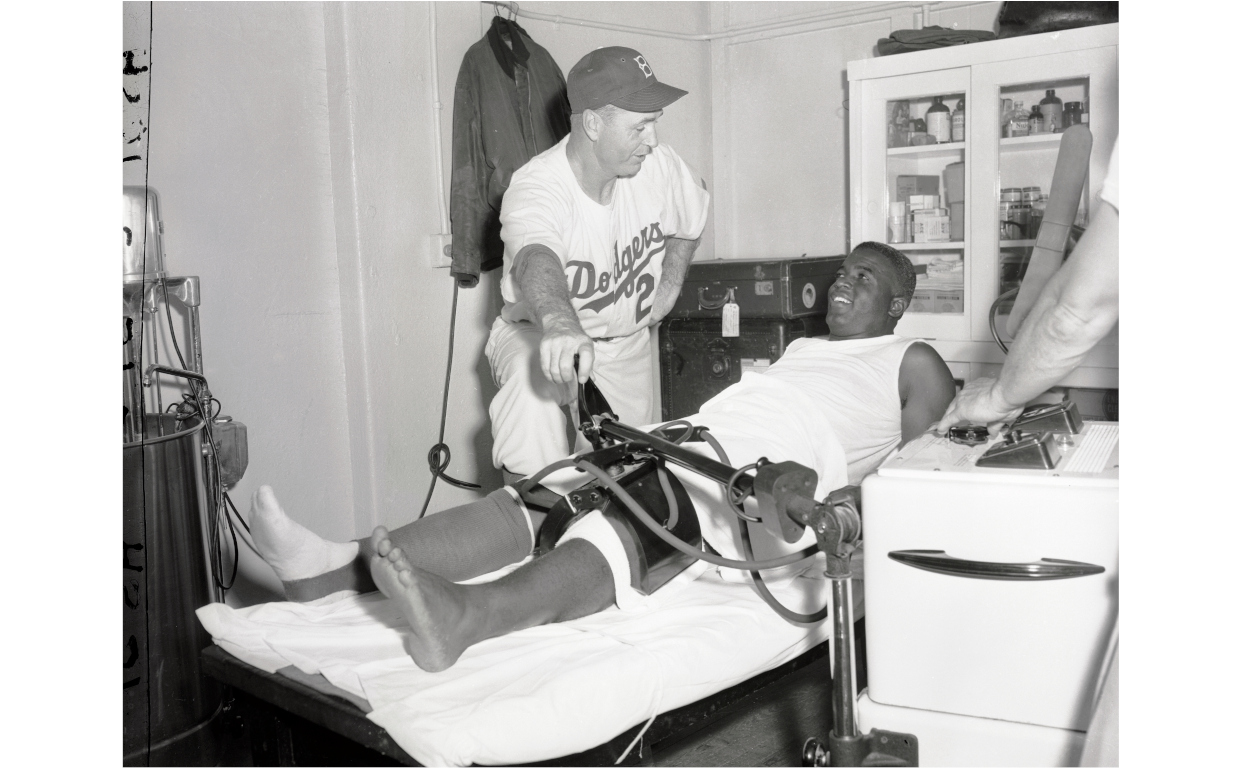
Walter Alston inspects Jackie Robinson’s knee as he receives treatment. Getty Images
Robinson also doubted Alston’s judgment as a manager and grew frustrated when he did not get his backing in disputes with Dodgers ownership or the baseball establishment. The two clashed frequently on and off the field, and their stormy relationship was frequently reported in the sports pages. Robinson doubted Alston’s judgment and continued to do so long after he had retired from baseball: In a primer for LIFE on the 1963 World Series, Robinson, now an executive at Chock Full o’Nuts and a respected civil rights activist, still took the time to remind readers that the Dodgers, in Alston, did not have a “take-charge guy” and that their greatest deficiency was a “lack of leadership.”6
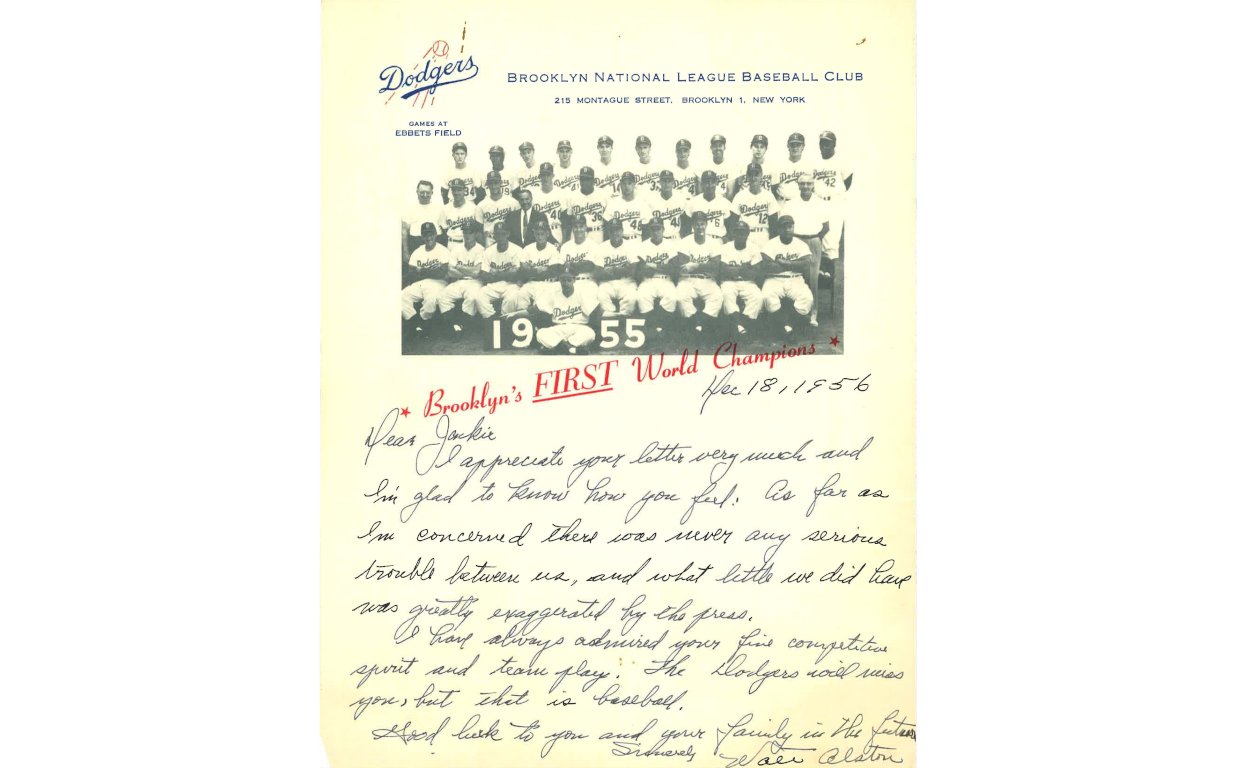
Walter Alston writes Jackie on team stationery after Robinson was traded to the New York Giants. Jackie Robinson Museum
Transcription:
Dear Jackie,
I appreciate your letter very much and I’m glad to know how you feel. As far as I’m concerned there was never any serious trouble between us, and what little we did have was greatly exaggerated by the press. I have always admired your fine competitive spirit and team play. The Dodgers will miss you, but that is baseball. Good luck to you and your family in the future. Sincerely, Walt Alston
Even so, the Alston-Robinson Dodgers continued to win. After a lackluster 1954, the Dodgers won their first World Series in Brooklyn under Alston in 1955 and won the National League pennant again in 1956. Though Robinson was slowing down, he remained respected as a leader, and his frustration with Alston did not appear to damage the cohesion of the remainder of the team. After Robinson was traded to the New York Giants after the 1956 season, Alston wrote to Jackie. “As far as I’m concerned, there was never any serious trouble between us,” he noted. “What little we did have was greatly exaggerated by the press. I have always admired your fine competitive spirit and team play.”7 Robinson and Alston, above all else, were professionals, and knew how to win better than just about anyone.
Robinson retired before the beginning of the 1957 season. He had hoped that a managerial job would be offered to him, but none materialized. Throughout his entire career, Robinson had been praised as much for his knowledge of the game as he was for his skill in the batter’s box and on the basepaths. Even those who admonished him for his outspokenness were readily willing to admit that he would be a top-flight manager. His relationships with the four men he played under demonstrated his love for the finer points, but Robinson was offered no opportunities to develop his skills even as a coach or minor league manager. Buzzie Bavasi, the Dodgers general manager who traded Jackie to the Giants, later recounted defensively to Rachel Robinson that he had told Jackie that he “was a perfectionist and would expect all your players to play the game the way you played it,” and thus (in Bavasi’s unclear logic) would not make a good manager.8
For the rest of his life, Jackie Robinson pushed for Black managers in baseball. His own experiences with alienation from his teammates and mistreatment from opponents showed him the importance of having a skilled manager at the helm. When baseball refused to bring him into the managerial fold, Robinson was disappointed but continued to agitate for diversity in the ranks of management until the day he died. These experiences were shaped by the close relationships he had with the four Dodger managers with whom he had worked—a manager’s understanding of the harsh realities of desegregation and the pressure that he endured could shape an entire season. Sometimes his relationships were friendly, and other times less so. He nonetheless learned from each of them.
Jackie’s willingness to speak clearly on the issue of leadership in baseball provided a useful framework for similar conversations in business, politics, and civil rights. The fight for a Black manager—unrealized until three years after Jackie’s death—was intimately tied for his struggles for equality in other aspects of American life. The role of a field manager is a deeply human one, one that Jackie Robinson understood on an intimate level. His knowledge of the game was matched only by the respect he had for and demanded from those with whom he shared it.
News
Robinson accomplished a great deal on the field, but a museum celebrating his life puts as much focus on his civil rights work.
READ MORE
News
Visitors will also get to explore an immersive experience “to better understand the racism and prejudice Robinson encountered beyond the baseball field, as well as stories of his lasting influence on sports, politics and entertainment today.”
READ MORE
Programs & Events
Get the scoop on new programs and resources for teachers, students, and families!
READ MORE