
News
The Jackie Robinson Museum Is About a Lot More Than Baseball
Robinson accomplished a great deal on the field, but a museum celebrating his life puts as much focus on his civil rights work.
READ MOREWhere was Ebbets Field?
It’s a question we get on a weekly basis at the Jackie Robinson Museum, and it’s not an easy one to answer. If you asked one of the many sportswriters who covered the Brooklyn Dodgers in the 1940s and ‘50s, they’d tell you confidently that Ebbets Field could be found in Flatbush, a description which remains practically synonymous with the team itself. For the millions of fans who lived and died with the team, the oddly shaped lot at the corner of Bedford and Sullivan might as well have been the center of the known universe. To a modern fan of baseball or Brooklyn geography, however, it would make little sense to describe the site of Ebbets Field as a part of Flatbush. When people ask, I often describe the location as “just north of Prospect Lefferts Gardens” or “at the southwestern part of Crown Heights.” For out-of-state history buffs, I’ll pick a more standard landmark, telling them that it was “east of the Botanical Garden and Prospect Park.” Most of the time, I take out my phone and point it out on a map.
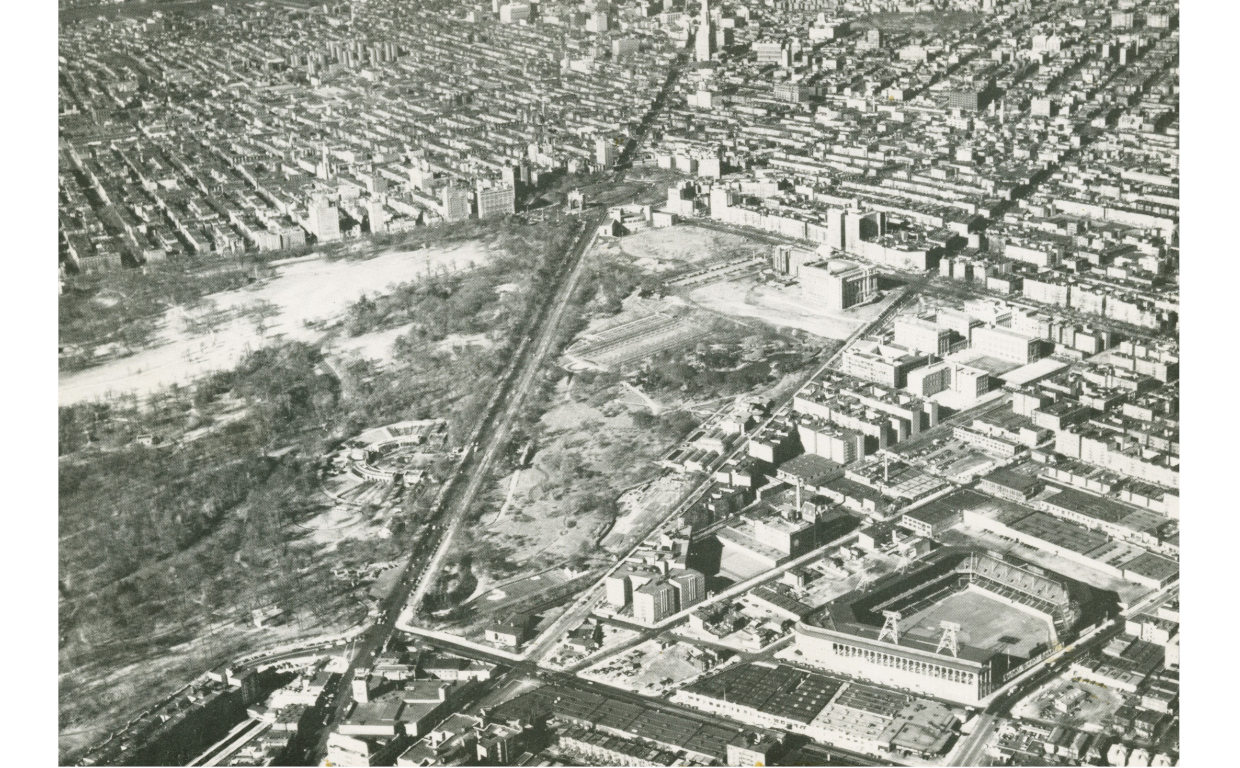
Aerial view of Ebbets Field in 1952. Prospect Park dominates the left-hand side of the frame, with Grand Army Plaza visible near the center. Brooklyn Public Library
In New York City, the names and borders of neighborhoods are as prone to change as the urban fabric itself. Describing the former location of Ebbets Field is perhaps the most difficult part of telling its well-worn story. For many Dodgers fans who remember the team’s halcyon midcentury days (and plenty who don’t), however, Flatbush is as much of a state of mind as it was a place, fixed in time like the Dodgers’ win-loss records. Ebbets Field doesn’t serve merely as a backdrop for the incredible storylines, it is often treated as a character in its own right, defined by the people that filled it, the overworked literary clichés used to describe it, and the role it played as the beating heart of a borough—especially for the fans inspired by the on-field triumphs of Jackie Robinson.
For all of the memories it conjures up, it is important to remember that the Ebbets Field of the Jackie Robinson days was a real place, with its own unique history that was defined by the economics of baseball as much as it was by the “colorful cast of characters” that filled its grandstands. Built in 1913 and named after Dodgers owner Charlie Ebbets, the stadium opened at the height of the boom of concrete and steel ballparks in the 1910s. Like the extant Fenway Park and Wrigley Field, these stadiums were built to be more fire-resistant than their predecessors, symbolizing not only advancements in technology but also the permanence of the two major leagues. Over time, the ballpark grew as the Dodgers became an established presence: Outfield bleachers were added in the 1930s, allowing the stadium to become almost fully enclosed. While the capacity of the ballpark changed frequently, it hovered around 33,000 seats during Robinson’s career—fewer than all but one major league park in use today.
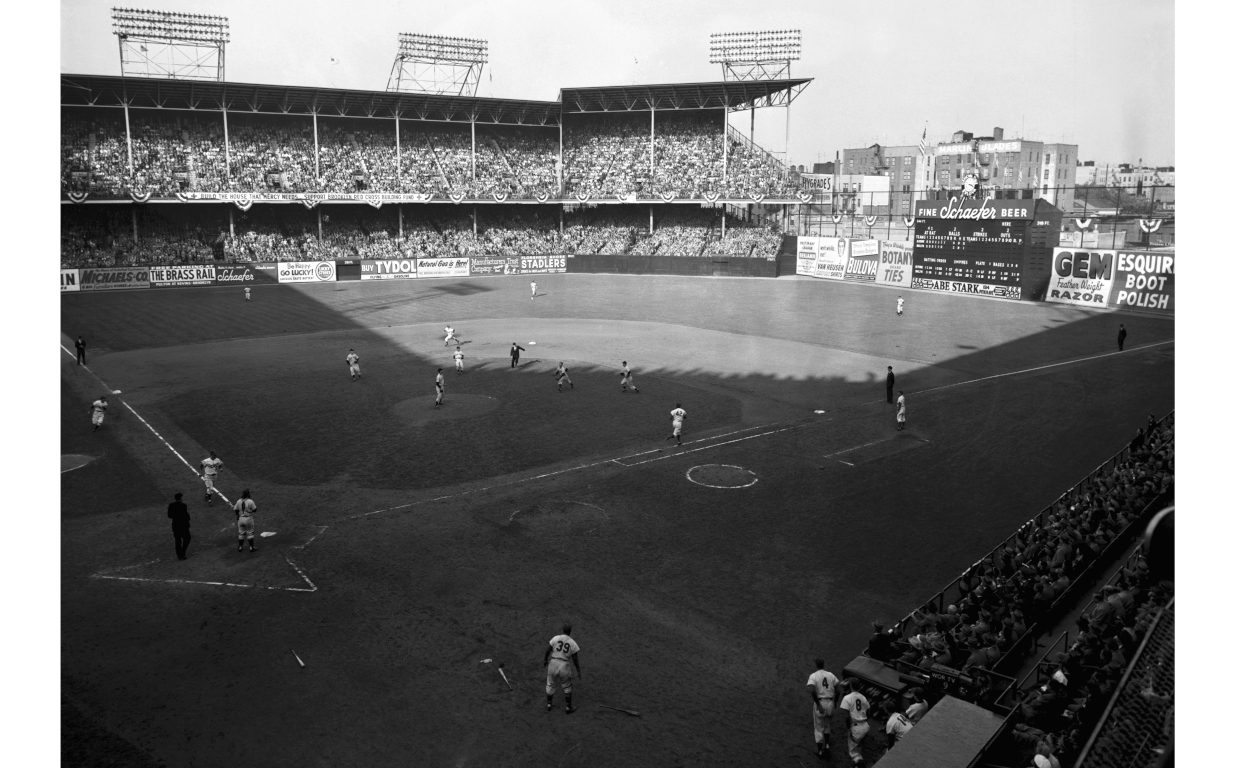
Ebbets Field in 1952. Getty Images
Similar to its cousins, Ebbets was also shaped by human geography. Its dimensions fit snugly into the lot that the team was able to purchase piece by piece in the years prior to its construction. No massive parking lots, shopping malls, or real estate developments could fit in the narrow tract of land. As a result, Bedford Street sat directly behind the right field fence, meaning the outfield wall stood a paltry 297 feet from home plate. Left-handed hitters—such as slugger Duke Snider—took advantage of the short fence.
The stadium’s embeddedness within the fabric of Brooklyn extended beyond the dimensions of the ballpark. During his first two seasons with the Dodgers, Jackie lived in Brooklyn—first Bed-Stuy (at 526 McDonough Street) and later in East Flatbush (at 5224 Tilden Avenue) and later in. Other teammates lived nearby as well, and many would recount how local children would follow them to and from the ballpark, asking for autographs. In an era in which owners could keep both overhead and player salaries low, living near the ballpark was often as much of a financial decision as it was anything else.
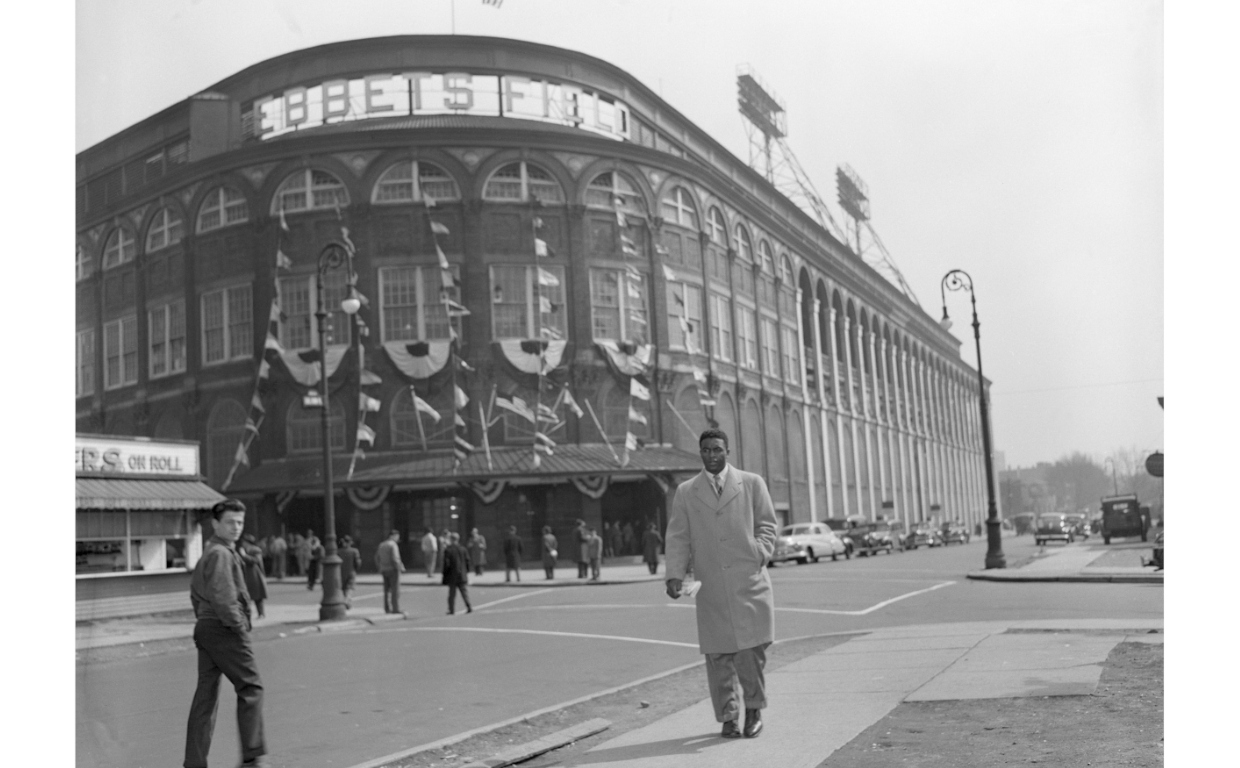
Jackie Robinson walks from Ebbets Field in 1947 after a game. Getty Images
They shared their community with the Dodger rooters as well. Fans, most of whom dressed sharply for a day out, rode the streetcars and subways to the ballpark. Don’t let the suits and hats fool you, though: a day at the ballpark was not just for the well-to-do. A grandstand seat in Jackie’s era cost two dollars, and a bleacher seat in the outfield even less. A middle-class family (or a young Brooklynite mysteriously absent from class that day) could afford a trip to the ballpark to cheer on their Bums.
Ebbets Field’s location also meant that the team played at the epicenter of one of the most diverse areas in the United States. The area directly around the ballpark was home to generations of Italian, Irish, and Jewish immigrants and their descendants. Further to the north, Black New Yorkers had been moving to the Bed-Stuy and Clinton Hill neighborhoods in the 1930s and 40s, eventually contributing to the fanbase after the signing of Jackie Robinson. Black fans in Harlem also frequently made the journey south to show their support for the societal transformation taking place at the corner of Bedford and Sullivan. Robinson, who was not a New Yorker by birth, threw himself wholesale into the civic life of Black New York as he took on the role of not just representing African Americans, but the diversity of the city he now called home.
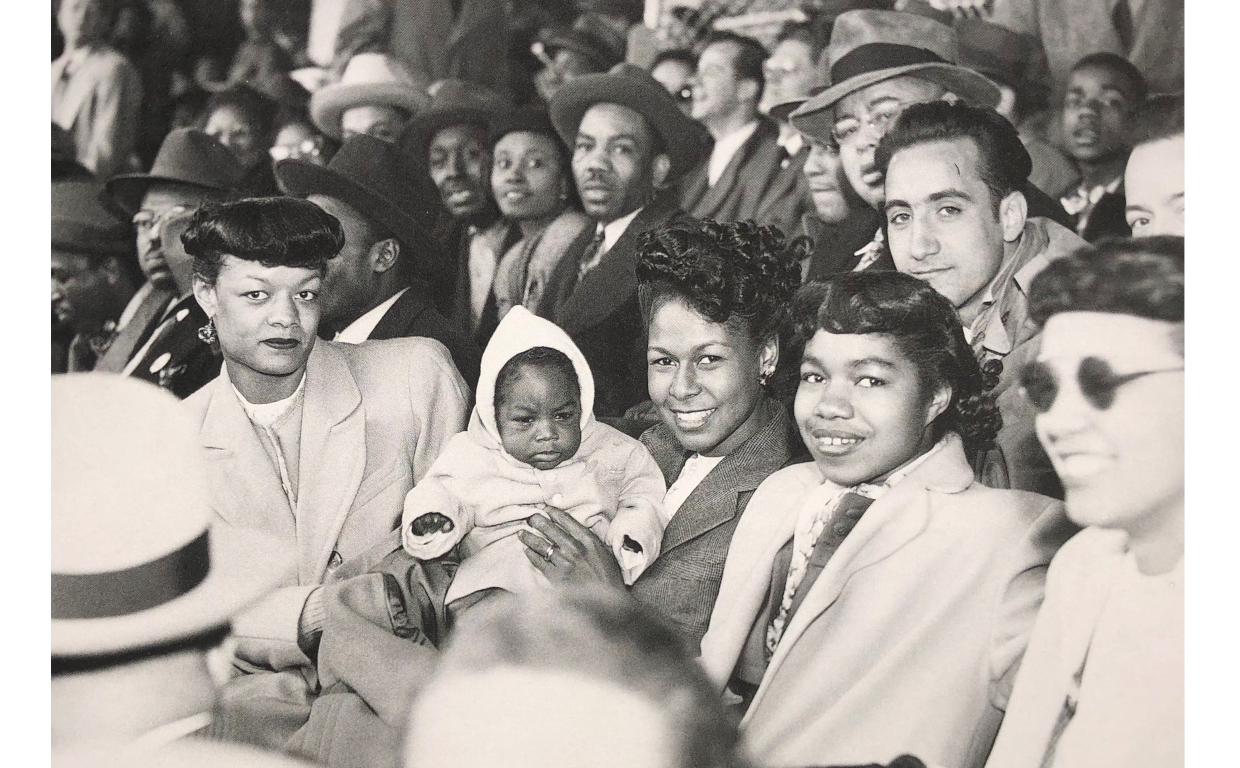
Rachel Robinson holds Jackie Jr. On the date of Jackie Robinson’s Dodgers debut, April 15, 1947
Within the ballpark, fans were “treated” to the cowbell of Hilda Chester, a Dodgers superfan who heckled opponents and umpires with her booming voice. Behind the first base dugout, the half-dozen “musicians” of the Dodgers Sym-phony joined in tormenting Dodger enemies as they entered and exited the field. Even the stadium advertisements have earned their place in history. At the base of the Schaefer Beer scoreboard in right field, Brooklyn clothier Abe Stark paid for a sign offering a free suit to any player who could hit the sign with a batted ball on the fly. While sources differ on exactly how frequently Stark was fitting free suits, the sign paid off in other ways. After his career in menswear, Stark used the popularity from the sign to begin a tremendously successful career in politics, rising to the rank of Brooklyn borough president from 1962 to 1970.
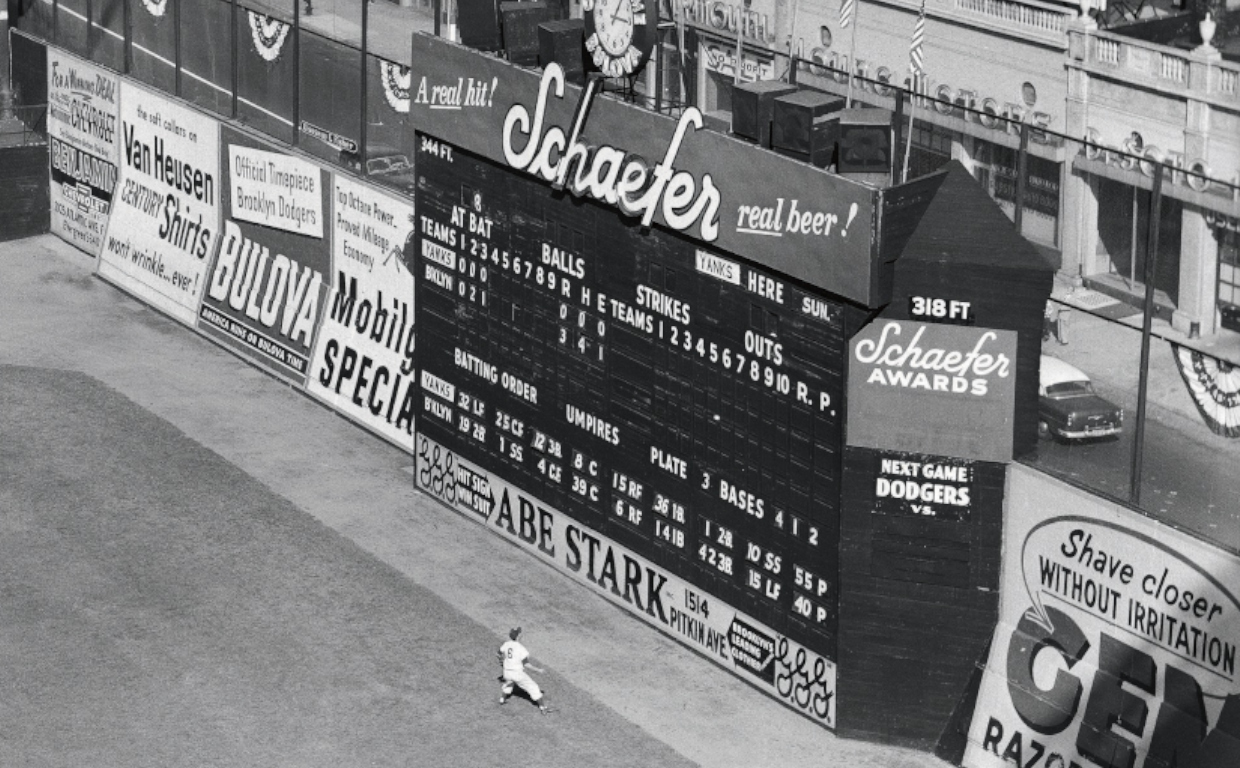
Stark’s sign appears at the bottom of the scoreboard in right field. Above the scoreboard, an advertisement for Schaefer Beer served a functional purpose: the “h” and “e” of the sign could be lit up to broadcast the official scorer’s ruling of hit or error.
The diversity of Brooklyn that is often celebrated in nostalgic depictions of the Dodgers, however, masked the underlying tensions that were reshaping American cities in the 1950s. Many of the white fans who were more than happy to cheer on Jackie Robinson and his Black teammates at the ballpark began to leave Brooklyn as the neighborhoods around the ballpark diversified. Increasing white incomes in the postwar era allowed many families to leave for the suburbs of Long Island, and televised games allowed fans to follow the team even when they were not participating in its civic life. This paradoxical relationship—that fans’ perception of diversity in sports might be different from diversity in their own communities—was a common theme experienced by Robinson and the other Black athletes who desegregated professional sport in the 1950s and ‘60s.
The Dodgers left Brooklyn for Los Angeles prior to the 1958 season, seeking greener pastures and greater profits as Americans headed west. For the fans who had lived and died with the Dodgers in Brooklyn, the loss of the team was devastating. The Black fans, many of whom are still sharing their stories of Robinson’s triumphs at Ebbets Field, were especially heartbroken, as the Dodgers were more than just a symbol of local culture. The realities of the business of baseball had triumphed over the spirit of the Brooklyn communities who had made Ebbets Field into the civic space it had become, leaving generations of fans embittered and angry. The ballpark represented some of the triumphs of a changing postwar America—triumphs unraveled by white flight, New York’s refusal to sell the Dodgers land for a new stadium, and team ownership that knew there was more money to be made out west.
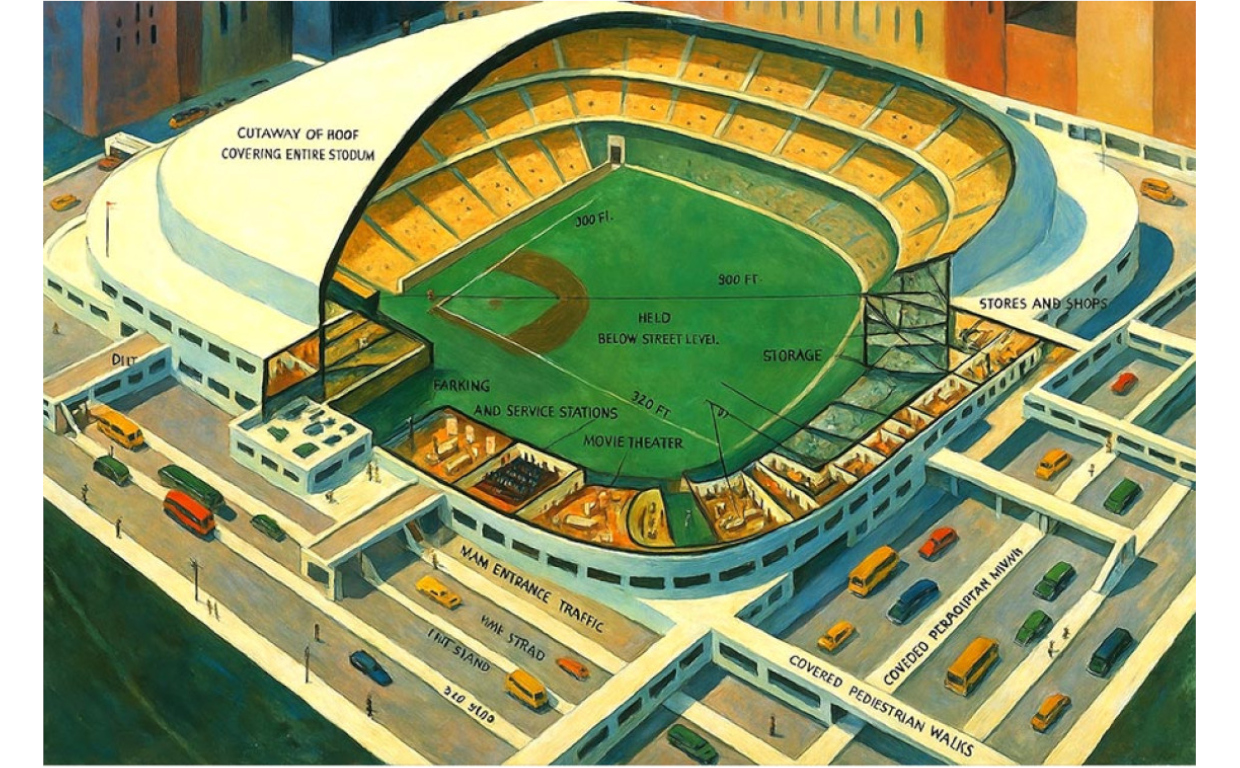
Dodger owner Walter O’Malley proposed a domed stadium to be built at Atlantic Terminal in Downtown Brooklyn. New York City Parks Commissioner Robert Moses refused to sell the team the land to build it. Collier’s Magazine
The land Ebbets Field once stood on is occupied by a large apartment building, home to hundreds of New Yorkers writing their own history of a changing neighborhood.
The loss of the Dodgers, still remembered by many visitors to the Jackie Robinson Museum, remains a defining element of the history of Brooklyn and the unique culture that has been built there. The memories of Ebbets Field are often colored by a rosy nostalgia of a time when baseball was supposedly less of a business and more of a community institution. Such depictions are often more fantasy than reality, but that should not cause us to forget the diverse millions made Ebbets Field their home in the forties and fifties. Like Jackie Robinson, these fans shaped the history of the borough. When Spike Lee donned number 42 in Do the Right Thing or Brooklynites in Bed-Stuy and Crown Heights do the same, they are not just honoring Jackie Robinson but the legacy of the Black fans who cheered him to six National League pennants and a World Series ring.
Perhaps that is the answer to the question at the beginning of this article. Ebbets Field might not have been located within the boundaries of today’s Flatbush. But it still remains in the hearts of millions who remember the Dodgers in Brooklyn and those who have worked to preserve the legacy of Jackie’s triumphs between its foul lines. The plot of land at Bedford and Sullivan still has plenty of stories left to be told. It’s up to all of us to keep sharing them.
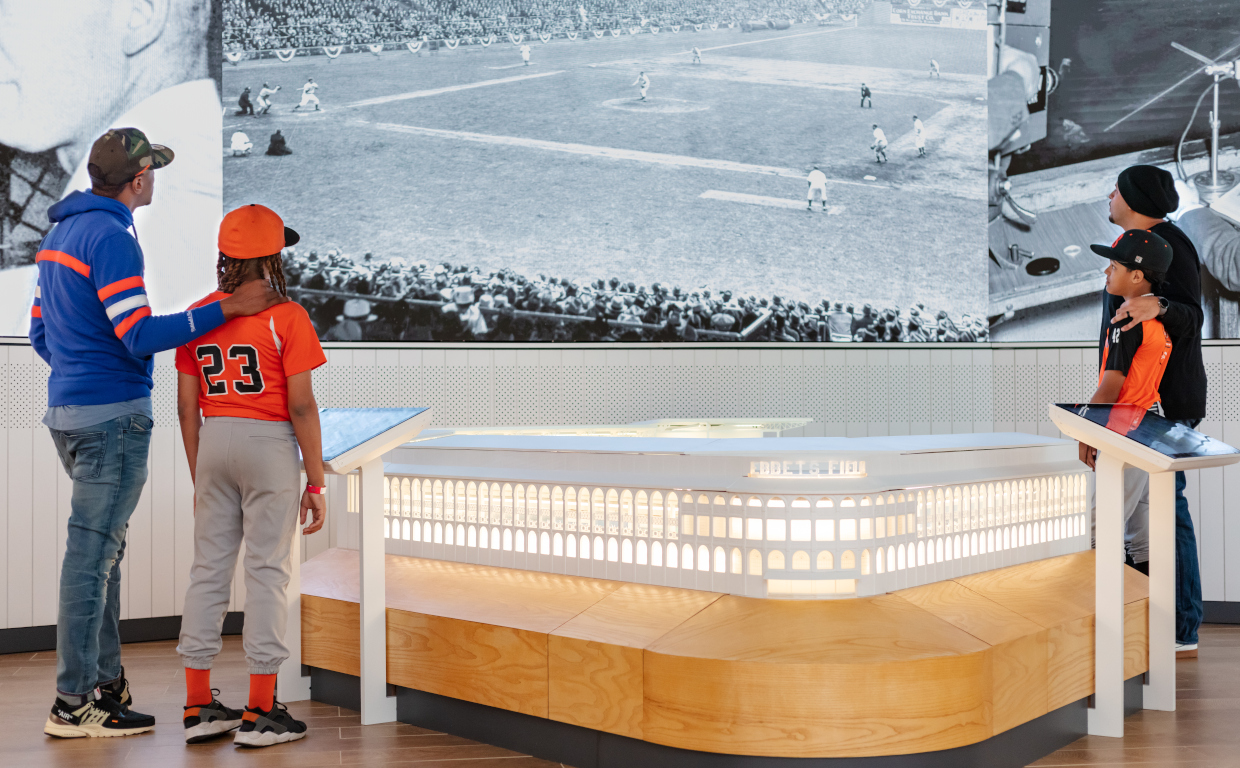
Fans view the scale model Ebbets Field at the Jackie Robinson Museum.
News
Robinson accomplished a great deal on the field, but a museum celebrating his life puts as much focus on his civil rights work.
READ MORE
News
Visitors will also get to explore an immersive experience “to better understand the racism and prejudice Robinson encountered beyond the baseball field, as well as stories of his lasting influence on sports, politics and entertainment today.”
READ MORE
Programs & Events
Get the scoop on new programs and resources for teachers, students, and families!
READ MORE