
News
The Jackie Robinson Museum Is About a Lot More Than Baseball
Robinson accomplished a great deal on the field, but a museum celebrating his life puts as much focus on his civil rights work.
READ MOREPlan your visit or become a member today! Join us at the Open House New York Community Day Oct 17!
On February 12, 1954, Jackie Robinson found himself in front of an auditorium of students at Will Rogers High School in Tulsa, Oklahoma. In less than a month, Robinson would report to spring training for his eighth season with the Brooklyn Dodgers. But for that afternoon, the youth of Tulsa held his attention. “I had a few qualms when I saw Tulsa on the itinerary,” Robinson told the Tulsa World. “But that feeling was completely dispelled when I visited [the] high school.” Robinson had been brought to Tulsa as an honorary chairman of National Brotherhood Week, an annual campaign from the National Conference of Christians and Jews, an early interfaith organization dedicated to fostering mutual goodwill.
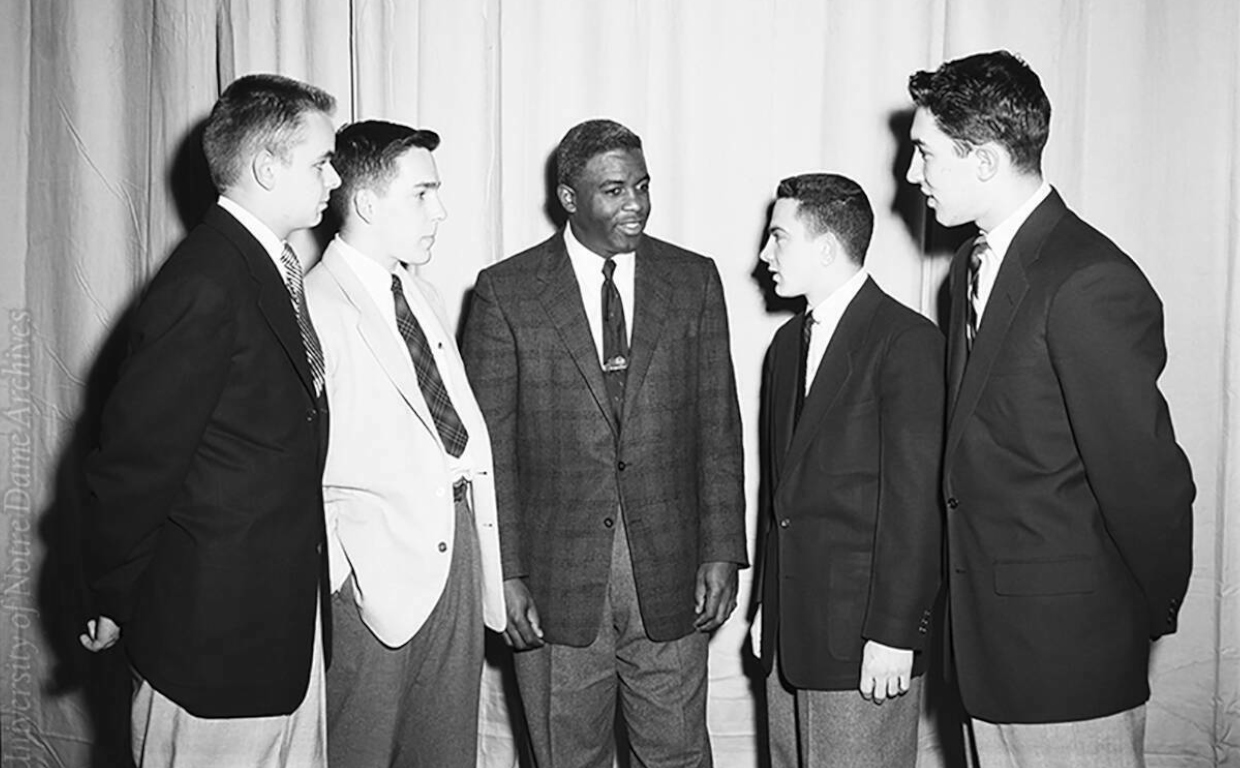
Jackie Robinson meets with students at the University of Notre Dame during his tour in 1954. Notre Dame Library
Robinson spoke to the students (as well as the local Lions Club) about his commitment to racial equality, deftly weaving in anecdotes about the game of baseball in his talks. Over the following weeks, he gave many such talks, crossing the country to bring his voice to new audiences. Despite his lack of formal training, Robinson quickly proved himself to be an effective messenger for this mission of bring people from different communities together. Over time, the NCCJ would be eclipsed by other organizations as the Civil Rights Movement advanced in earnest. Robinson, too, would soon devote his time and energy to other causes as these groups began to confront segregation and inequality more directly. But in the 1950s, as baseball continued to occupy the majority of Robinson’s time, the NCCJ’s events served as an effective proving ground for his message of justice. The tools he built at their lecterns and luncheons would prepare him tremendously for the tougher fights to come.
The choice of Jackie Robinson as a representative was not exactly a natural fit for the National Conference of Christians and Jews. When the organization was founded in 1927, its mission had little to do with racial justice. Instead, it emerged as a coalition of faith leaders and lay people interested in responding to both antisemitism and anti-Catholic sentiment in the reactionary 1920s. By the end of the decade, the latter was a significant concern. Catholic New York Governor Al Smith, who sought the presidency in the 1928 election, was the target of bigoted and outrageous commentaries and political cartoons, many of which conspiratorially suggested—or said outright—that a vote for Smith would put the Pope in charge of the United States. The Ku Klux Klan, itself undergoing a massive resurgence, further stoked antisemitism and anti-Catholicism in addition to its broader project of white supremacist violence across the South and North. Smith’s campaign and the vitriolic response to it helped many across the country realize the need for interfaith understanding.
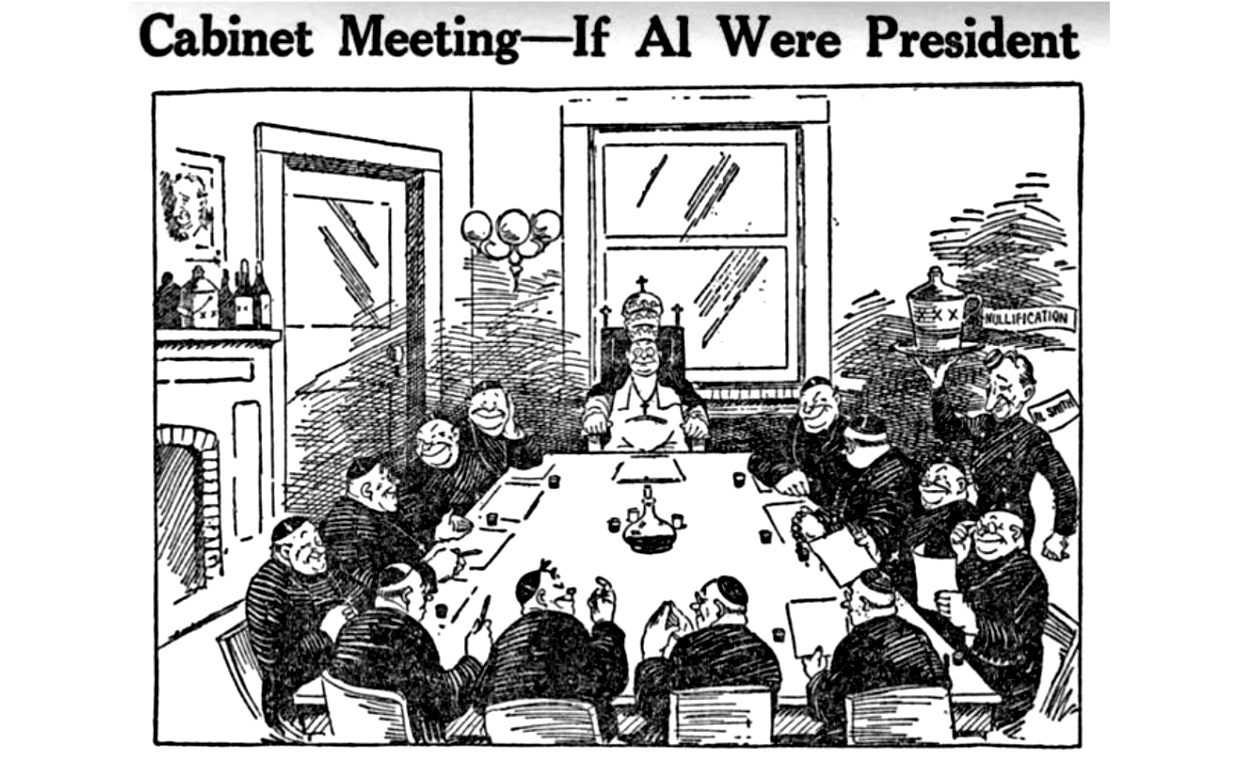
This anti-Catholic cartoon, printed in a newspaper allied with the Ku Klux Klan, depicts presidential candidate Al Smith at right waiting on a cabinet of cardinals. Cartoons like these—which often included jabs at Smith’s Irish background—were commonplace during the campaign. Wikimedia Commons
As the Depression and the Popular Front swept through America in the 1930s, the organization quickly grew in both capacity and influence. Soon, they could afford radio spots on stations across the country, and local branches rapidly sprung up from coast to coast. Among the organization’s interventions were the “Tolerance Trios,” traveling groups featuring a Protestant minister, a Catholic priest, and a rabbi who would tell jokes and talk about stereotypes.
In 1934, the organization launched “National Brotherhood Day,” the campaign for which it would earn the most renown. Over time, the celebration expanded to a week, which generally occurred near the end of February. Robinson was selected as chairman for community organizations for the 1954 edition of National Brotherhood Week. As struggles for racial equality were continuing to bubble to the surface of American civic life, Robinson was an in-demand speaker. His specific experience (integrating one of the most high-profile workplaces in the country) combined with his fame as a ball player made him a desirable messenger. Though he had no formal training in this type of work, his working-class background combined with his UCLA education gave him extensive preparation to speak to a vast range of audiences, most of whom eagerly listened to his every word.
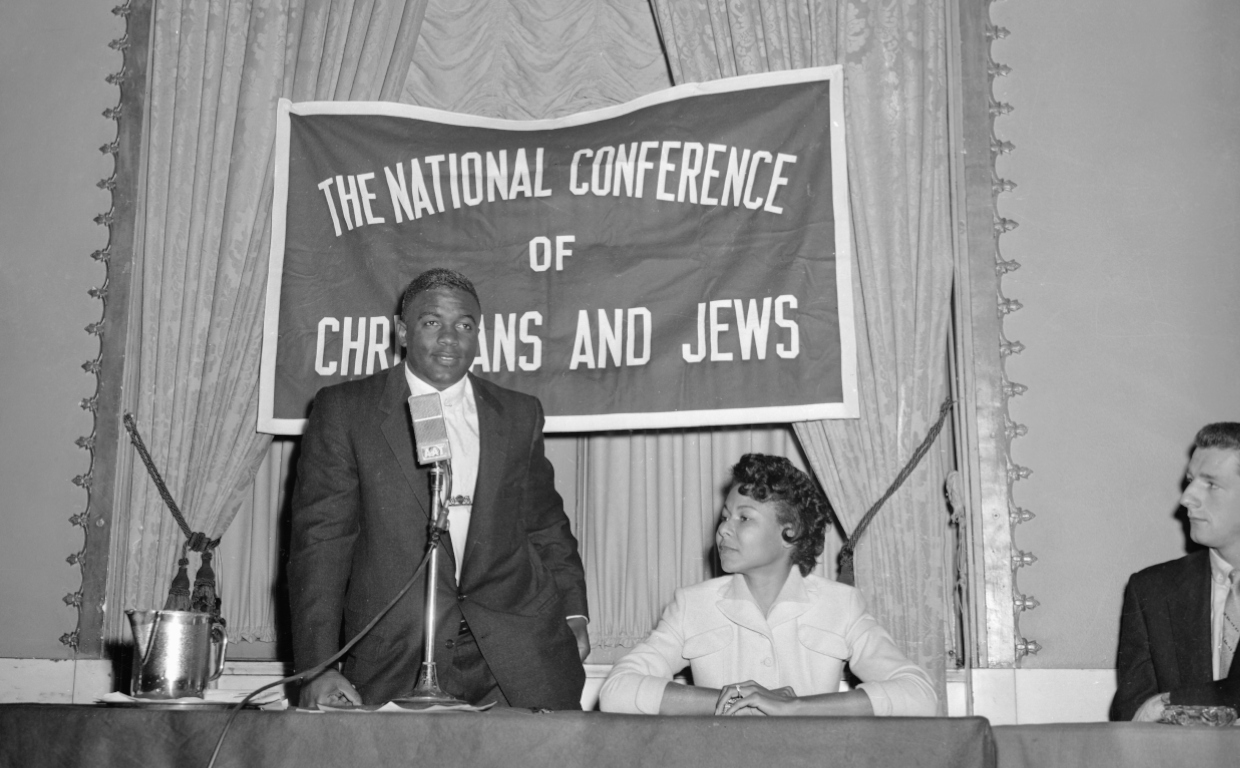
Jackie Robinson speaks at an annual NCCJ conference in 1957
In addition to his visit to Tulsa, he traveled to Detroit, Pittsburgh, South Bend, St. Louis, and the Los Angeles area on his tour in 1954. During his visits, Robinson spoke plainly to his assembled audiences. He drew from his personal experiences in baseball but often made commentaries on larger issues around geopolitics and equality. Speaking to a crowd at a Detroit event, Robinson remarked that “many smaller nations are sending their students to the United States to observe our methods of freedom and democracy,” and that Americans needed to actually live up to those ideals to maintain the nation’s global standing. Appeals like these were not uncommon at the events of Cold War-era social welfare groups. In press packages from that year’s National Brotherhood Week, one editorial-writer framed the role of the NCCJ in even more blunt terms: “No one would be happier than Soviet Russia,” wrote Virginius Dabney, editor of the Richmond Times-Dispatch, “if the Catholics, Protestants, and Jews of the United States could be brought to hate and distrust one another.” Like the NAACP and the National Urban League, the NCCJ saw the Cold War as an opening to push for equality in race and religion, even as the Red Scare targeted similar groups. Robinson, too, was aware of this: As Howard Bryant has discussed in his recent book, Kings and Pawns, Jackie’s 1949 testimony in front of the House Un-American Activities Committee informed his interest in navigating this intersection.
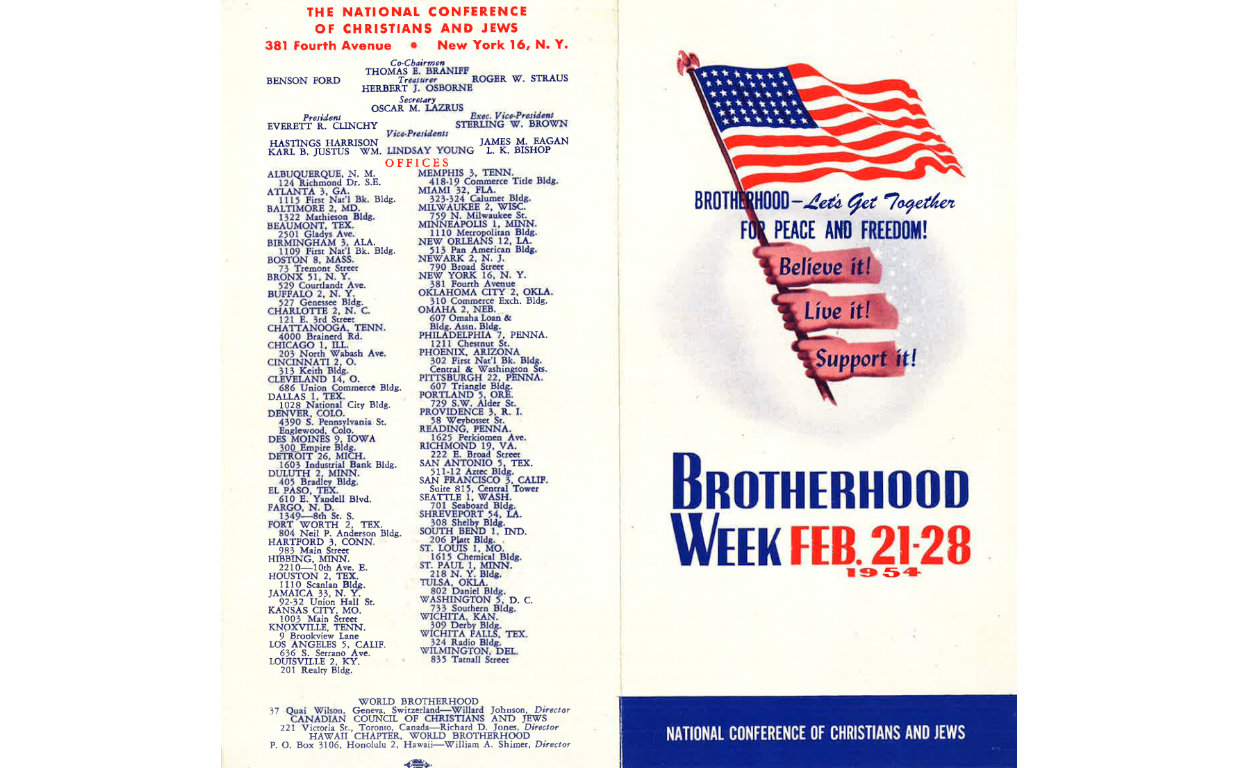
Promotional materials for 1954’s National Brotherhood Week. Social Welfare History Archives, University of Minnesota
Robinson also used the tour to examine issues facing Black communities across the country. In Los Angeles, he noted that segregated housing and racist banking practices were some of the biggest barriers to equality, and that school desegregation was one of his most important short-term goals. For Robinson, his talks allowed him to advance beyond the loose theme of ”Brotherhood” and confront some of the realities blocking the advancement of Black America. Positive messages could be mixed with hard truths, pushing white audiences outside of their comfort zone and earning the trust of Black listeners who may have been skeptical that Robinson could truly be a messenger of change.
As the Civil Rights Movement began in earnest over the next decade, other organizations quickly eclipsed the influence of the NCCJ, Robinson, for the most part, turned his attention to other projects as well, devoting extensive time to the NAACP in the latter half of the 1950s. As confrontations over racial justice became more pronounced and children were being attacked by police dogs in the streets, platitudes about neighborliness and brotherhood began to feel more hollow for many Americans. National Brotherhood Week is still remembered as the target of satirical folk musician Tom Lehrer’s 1965 tune of the same name, in which he reassures listeners that “It’s only a week so have no fear / Be grateful that it doesn’t last all year.”
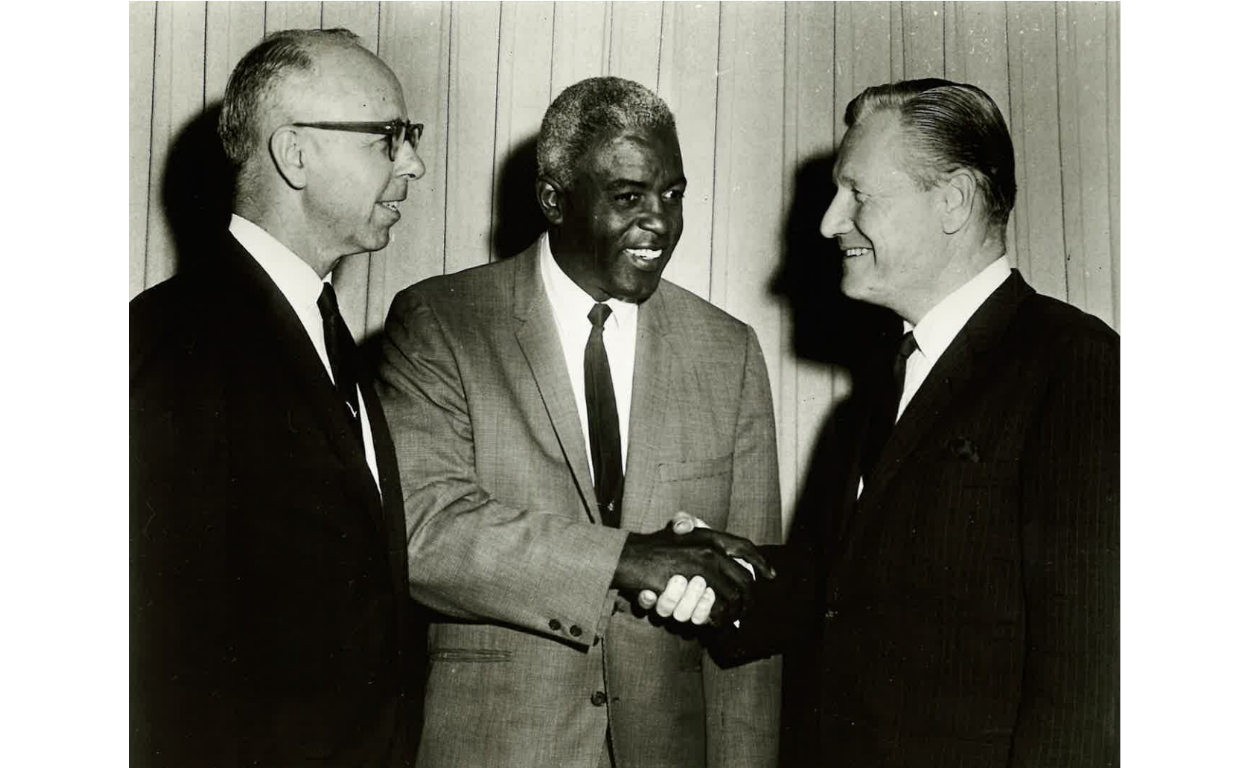
Sterling W. Brown (left), president of the National Conference of Christians and Jews, shakes Jackie Robinson’s hand as he is announced as honorary chairman of National Brotherhood Week in 1968. New York Governor Nelson Rockefeller (right) looks on. Social Welfare History Archives, University of Minnesota
Robinson later served as an honorary chairman again in 1968, though by this time, his work as a seasoned civil rights advocate had moved far beyond the NCCJ’s Tolerance Trios and saccharine radio ads. But just as Robinson’s athletic career began on the sandlots of Pasadena, the school auditoriums and the Lions Club dinners he graced helped prepare him for the fights to come. In a world that was determined to stop Robinson from speaking out, the National Conference of Christians and Jews offered him one of his first serious platforms to speak his mind. As he did so, he earned himself even more fans ready to join him in the struggle for racial justice and equality.
News
Robinson accomplished a great deal on the field, but a museum celebrating his life puts as much focus on his civil rights work.
READ MORE
News
Visitors will also get to explore an immersive experience “to better understand the racism and prejudice Robinson encountered beyond the baseball field, as well as stories of his lasting influence on sports, politics and entertainment today.”
READ MORE
Programs & Events
Get the scoop on new programs and resources for teachers, students, and families!
READ MORE