
News
The Jackie Robinson Museum Is About a Lot More Than Baseball
Robinson accomplished a great deal on the field, but a museum celebrating his life puts as much focus on his civil rights work.
READ MOREAuthor Roger Kahn had one of the best views of Jackie Robinson’s career as any sportswriter in baseball. Kahn followed the Brooklyn Dodgers in their halcyon years in the 1950s, writing copy for the New York Herald Tribune and, in his later years, he became one of the most prominent purveyors of Dodgers nostalgia. On Robinson, wrote Kahn in his 1972 The Boys of Summer, shortly before Jackie’s untimely death at age 53:
“As surely as [his] genius transcends his autobiography,” it also transcends the record books. In two seasons, 1962 and 1965, Maury Wills stole more bases than Robinson did in all of a ten-year career. Ted Williams’ lifetime batting average, .344, is two points higher than Robinson’s best for any season. Robinson never hit twenty home runs in a year, never batted in 125 runs. Stan Musial consistently scored more often. Having said those things, one has not said much because troops of people who were there believe that in his prime Jackie Robinson was a better ball player than any of the others.”
Kahn understood something about Robinson’s career that has eluded most who have only given a cursory glance over his Baseball Reference page or bemoaned how segregation robbed him of what could have been his prime years. He knew that Robinson could give the Dodgers the spark they needed in the moment they needed it. He knew that Robinson’s bat, glove, and blazing speed were only matched by one of the most brilliant baseball minds our game has ever seen.
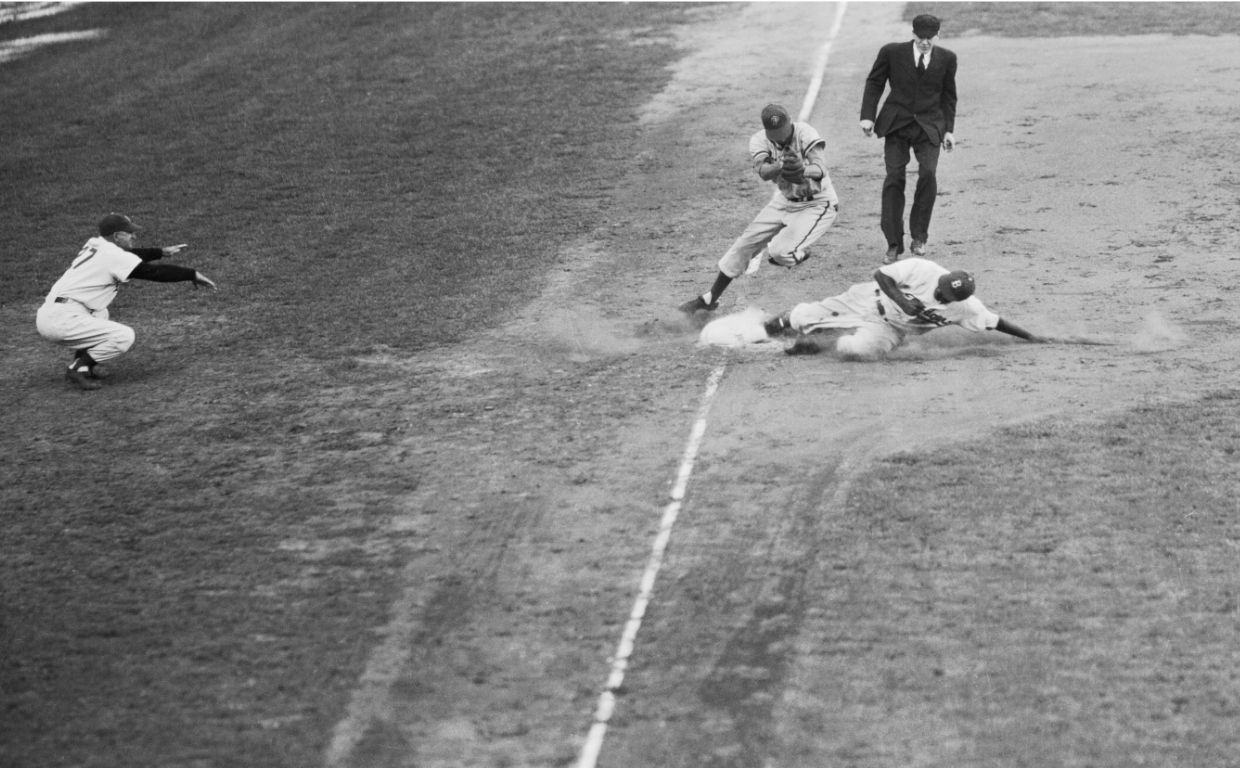
Jackie Robinson successfully steals third base against the Philadelphia Phillies in 1949. His feet-first slide just beats the throw of Philly catcher Andy Semnick. Getty Images
More than anywhere else, Robinson’s baseball mind was at its most active on the basepaths. Over ten years in Brooklyn, Jackie Robinson stole 197 bases, including home plate 19 times. He led the National League in stolen bases twice, in 1947 and 1949, and was adept at going from first to third on base hits, which happened frequently over a decade spent in fearsome Dodger lineups. When he wasn’t stealing, he could induce bewildered pitchers into making balks and distract them so viciously that they would leave pitches over the plate for Roy Campanella or Duke Snider to launch into the Ebbets Field bleachers. His baserunning style changed the way baseball was played and continues to define the legacy and memory of one of baseball’s fiercest competitors.
Robinson’s movements on the basepaths often goaded pitchers into balking. Here, Robinson finds a creative way to advance a base during the 1947 World Series.
It was this baserunning ability, further honed during his time in the Negro Leagues in 1945, that caught the eye of Branch Rickey when Robinson was signed to the Dodgers organization late that year. When Rickey was searching for a player who would integrate the game of baseball, he was not just looking for a player with the courage not to fight back against the insults and slurs of opponents, or someone who could merely make the grade as a ball player. He was looking for a player who could excite the throngs of people who would flood through the turnstiles to see him. “I want you to run wild,” Rickey told Robinson in spring training in 1947. “I want you to steal the pants off them, to be the most conspicuous player on the field”1. Rickey and the Black sportswriters who supported Robinson saw not just an opportunity to change the color of the game, but the way it was played.
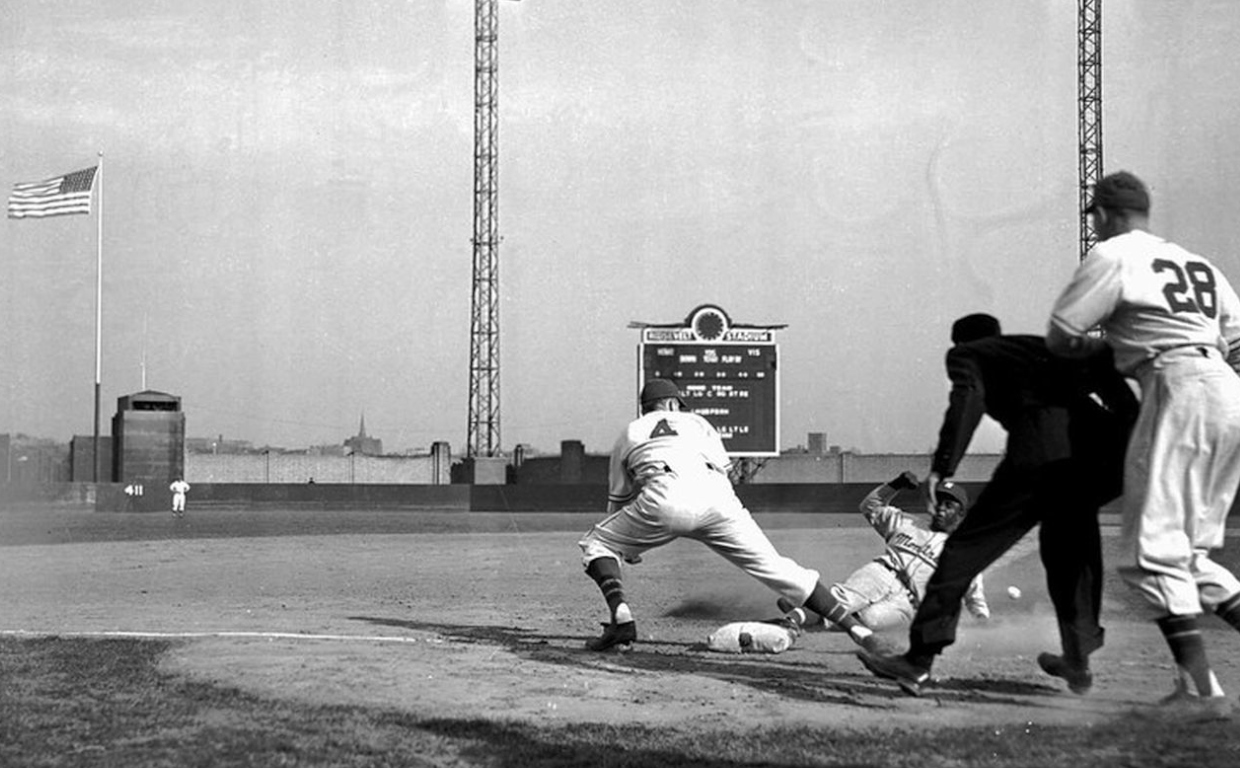
Robinson slides into third base during his first game in the minor leagues with the Montreal Royals. In 1946, Robinson dazzled International League fans and opponents with his fury on the basepaths. He stole 40 bases that year—more than he would in any season with the Dodgers. Associated Press
Robinson took the National League by storm. Making his debut on April 15, 1947, Jackie put his speed on display as his mad dash down the first base line on a bunt forced a Boston infielder to make a hurried and errant throw. From there, he got to work. On June 24. 1947 in Pittsburgh, Robinson gave Pirates hurler Fritz Ostermueller a taste of the new reality. In the fifth inning, with Jackie on third and Carl Furillo at first, Robinson faked a dash for home, leaving the Pirate battery so stunned that Furillo easily advanced. Ostermueller, not sensing the threat at third base, returned to his slow windup motion. Then, on the next pitch, Jackie broke for home, hooking a slide just under Dixie Howell’s tag.2 For Robinson, it was revenge: Ostermuller had been one of the pitchers who had thrown beanballs at Jackie earlier that year.
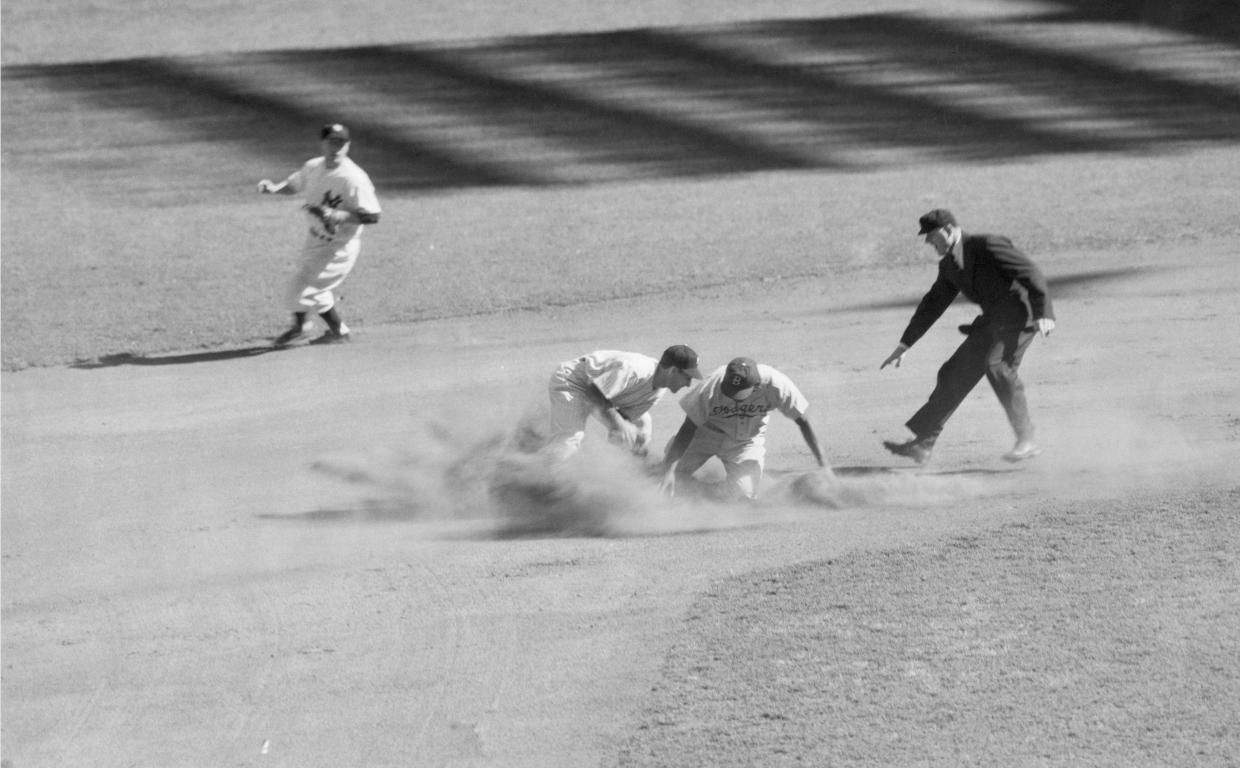
Jackie steals second base in the 1947 World Series against the Yankees. Getty Images
Robinson finished his first season with 29 stolen bases and 28 sacrifices, both tops in the National League. Those stats, combined with his remarkable contact hitting (he turned in a cool .297 batting average) earned him the Rookie of the Year award. In contemporary baseball, a Rookie of the Year at age 28 is essentially unheard of. But Jim Crow had robbed Jackie of what could have been some of his best years in the game. With only a few dozen games with the Kansas City Monarchs and a brief stint in the minors with the Montreal Royals, Robinson’s experience in professional baseball was remarkably limited. Many of Robinson’s teammates first faced big league pitching in their early twenties: Pee Wee Reese got his start at 21, and Duke Snider at 20. Even Gil Hodges got his “cup of coffee” at age 19 before serving in the Second World War. Jackie had no such advantages. As he dashed around the basepaths and reshaped the way baseball was played, he was also catching up to his peers who were unburdened by discrimination.
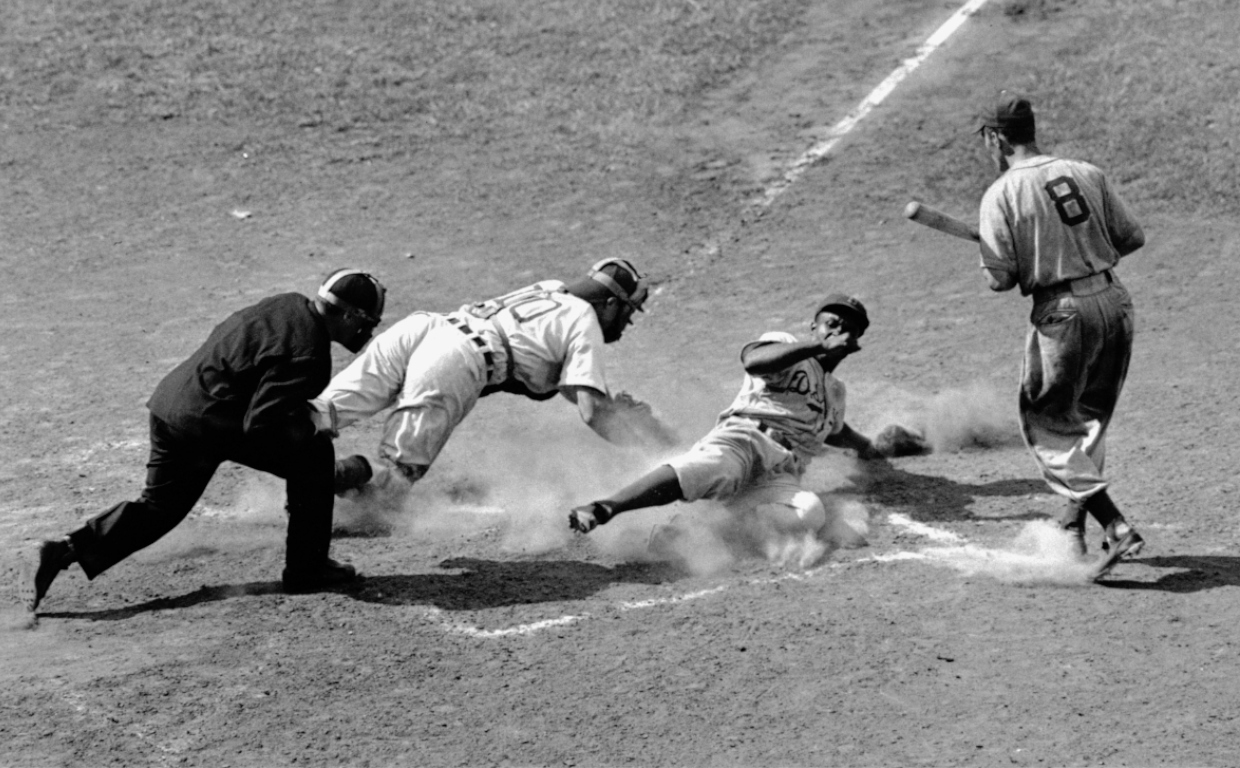
Not every mad dash was successful. Here, Robinson is tagged out by the Chicago Cubs’ Clyde McCollough as he attempts to steal home in a 1948 game. George Shuba, wearing number 8, scampers to avoid the play. Associated Press
He was not catching up for long. In 1949, Robinson led the NL in stolen bases once again, this time with 37. As he aged, his legs slowed down, but his baseball mind did not. He knew more than anyone else that good baserunning takes a lot more than quick feet. Many of his baserunning triumphs were not borne of blazing speed, but his daring fakes and leads that would goad pitchers into balking, or his razor-sharp presence of mind to know when to advance an extra base. His quick wit allowed him to continue dominating the basepaths well into his thirties, even as his hair began to gray and he was shifted to less demanding positions in the field.
So it was this presence of mind that defined the steal of home, Robinson’s signature play. Robinson stole home 19 times across his career. Only eight players had more, and all of them played prior to baseball’s integration in 1947. Moreover, all of the players with more—a list that includes luminaries such as Ty Cobb and Honus Wagner—enjoyed at least an extra half-decade of major league play compared to what Robinson was afforded. He brought a type of excitement to the game that had not been seen in decades, and fans duly rewarded him for it.
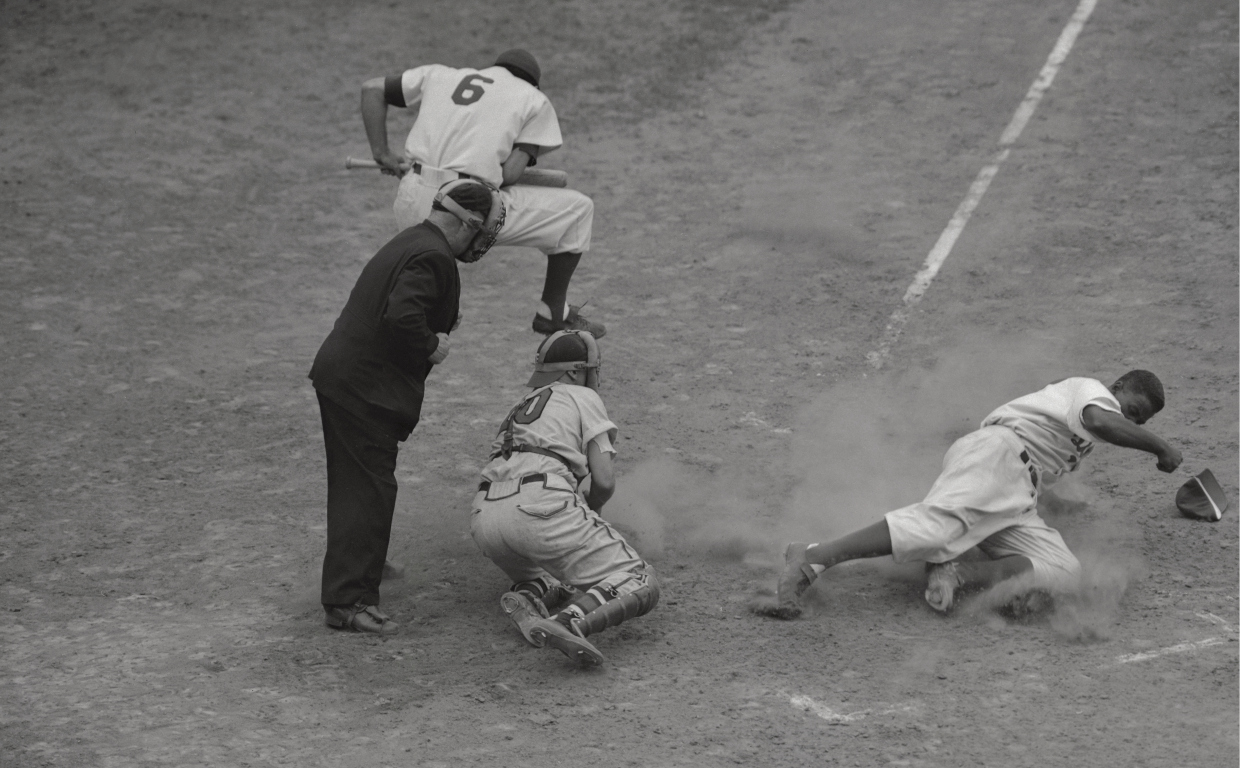
Robinson swipes home in a 1948 game against the Boston Braves.
It was fitting, of course, that Robinson’s finest moment in baseball happened on the base paths. Jackie’s Dodgers faced the Yankees in the 1955 World Series for the fifth time in nine years. In each of their previous four matchups, the Dodgers came away empty-handed. The “Bums’” futility in the World Series had become something of a joke over the previous decade, and Robinson and his teammates were itching to prove their detractors wrong.
By the eighth inning of Game 1, the Dodgers were down by two runs, with only Jackie on third base. By any reasonable definition, it was not time for boldness. Robinson certainly understood that, as he was caught stealing home twelve times over his career. Making a dash for home—that wouldn’t even tie the game—and getting caught stealing? It would be an embarrassment for the ages.
Jackie Robinson slides into home plate in Game 1 of the 1955 World Series.
Jackie knew the Dodgers needed a spark. With the burden of history weighing heavily upon him, he danced off third base and broke for home. Against a pitcher like Ford, ninety feet might as well be a hundred miles. Ford’s pitch was low and beat Robinson to the plate. But a well-hooked feet-first slide got Jackie in before the tag, prompting an immediate “safe” call from umpire Bill Summers. Yogi Berra, who planted the late tag on Robinson, protested mightily, but to no avail.
Jackie understood that the decision to steal might have been unorthodox at best and foolish at worst. Berra noted, “Whitey [Ford] was just as surprised as I was. If he had been the tying run I can see why he should come.”3 Robinson put it more simply. “It doesn’t make any difference to me,” he noted. “When I get a chance to go, I go. Two runs…16 runs. What’s the difference?” The Dodgers, of course, lost the game. But they eventually rumbled back in Game 7 to win their only World Series in Brooklyn. To this day, Robinson’s steal is remembered not just as a brilliant play, but as the defining moment of midcentury Dodgers baseball.
Jackie Robinson dances off first, then steals second, in an unknown video.
Jackie Robinson’s remarkable career was defined by his aptitude as a baserunner, though he excelled at all aspects of the game. Little Leaguers to this day wear their socks high in his honor. People of all ages and backgrounds look up to Jackie not just because of his role in reshaping American society, or his general skill as a ballplayer. They revere him because they know that he brought a type of excitement to the way baseball was played that had not been seen before, and that his determination to leave his mark on the game led to the dazzling steals that players try to emulate today. When Kahn invoked the troops of people who say that Robinson was the best of his era, he did so knowing that these fans would be vindicated not just by the flair of his baserunning style, but by the results and victories that it brought.
News
Robinson accomplished a great deal on the field, but a museum celebrating his life puts as much focus on his civil rights work.
READ MORE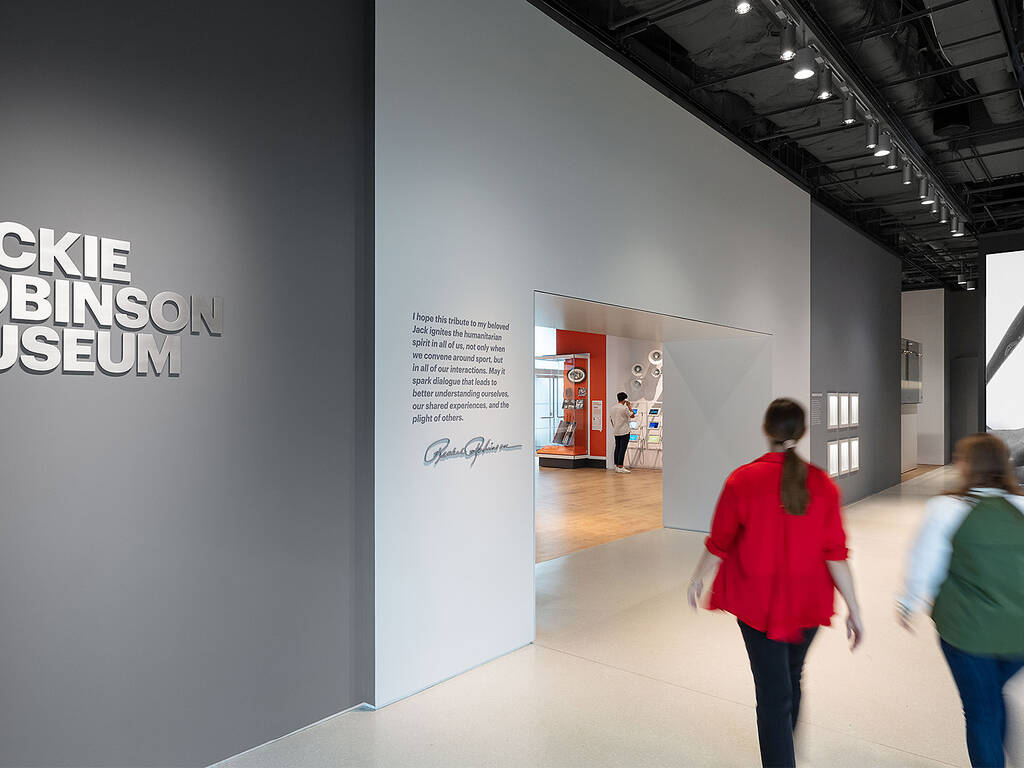
News
Visitors will also get to explore an immersive experience “to better understand the racism and prejudice Robinson encountered beyond the baseball field, as well as stories of his lasting influence on sports, politics and entertainment today.”
READ MORE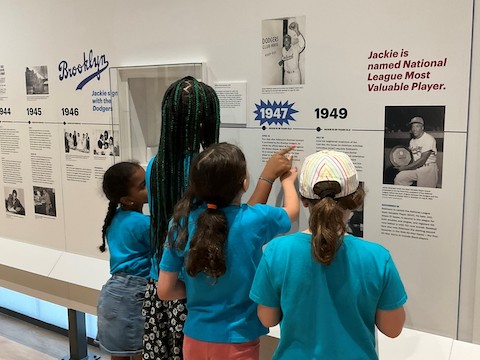
Programs & Events
Get the scoop on new programs and resources for teachers, students, and families!
READ MORE